What Is SMS Marketing?
SMS Marketing refers to the use of text messaging for promotional, informational or transactional communication with customers, leads or business contacts.
Today, business SMS communication is widely used for:
- promotional campaigns
- OTPs and verification codes
- appointment reminders
- delivery notifications
- customer support updates
- personalized communication campaigns
- omnichannel customer engagement workflows
Unlike many other communication channels, SMS does not rely on internet connectivity, app installations or visibility algorithms, making it particularly reliable for immediate and time-sensitive communication.
Why SMS Marketing Is Growing Again
For years, many businesses viewed bulk SMS messaging as a “traditional” communication channel. Today, however, the landscape has changed dramatically.
SMS remains one of the most direct communication channels worldwide:
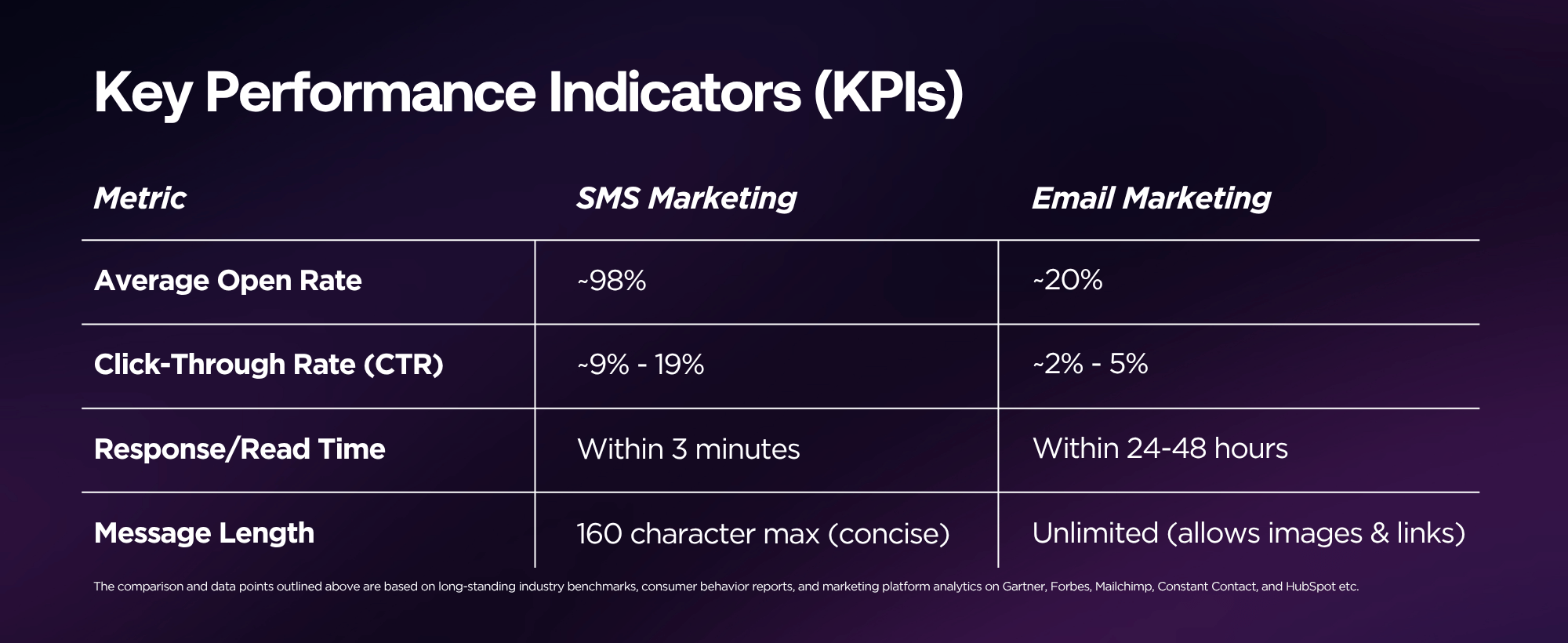
- exceptionally high open rates
- instant message delivery
- real-time engagement
- strong delivery reliability
- mobile-first communication
- immediate customer interaction
Especially in B2B SMS communication environments, where speed and reliability are critical, SMS can function as a strategic touchpoint rather than simply a “mass notification” tool.
Common SMS Marketing Use Cases
- OTPs & verification codes
- appointment reminders
- delivery updates
- promotional SMS campaigns
- internal business alerts
- customer support notifications
- omnichannel remarketing workflows
- transactional SMS communication
The real value of SMS today goes beyond immediacy. Its strength lies in the fact that it can now be integrated into broader omnichannel customer journeys and automated communication workflows.
Why Email Marketing Still Matters
Despite the rapid growth of mobile-first channels, email marketing continues to be a cornerstone communication tool for most businesses, and for good reason.
Email offers:
- Greater storytelling capabilities
- Rich branded communication
- Advanced automation features
- Segmentation & personalization
- Analytics and behavioral insights
- Long-term nurturing opportunities
For content-heavy communication, newsletters, onboarding sequences, or B2B lead nurturing, email marketing remains highly effective.
Inbox Fatigue Continues to Increase
One of the biggest challenges of email marketing today is growing inbox fatigue. Users receive dozens of emails every day, making it increasingly difficult for brands to stand out through email communication alone. This is exactly where omnichannel communication becomes strategically important.
SMS Marketing vs Email Marketing: Not Competing Channels
One of the biggest mistakes businesses make is treating SMS Marketing and Email Marketing as competing strategies.
The most mature communication ecosystems combine both channels strategically.
Email is ideal for:
- Detailed content
- Nurturing
- Long-form communication
- Educational sequences
- Newsletters
- Branded campaigns
SMS is ideal for:
- Immediacy
- Urgency
- High visibility
- Transactional communication
- Reminders & alerts
- Time-sensitive campaigns
The real value is created when these channels operate through unified and integrated messaging strategies.
For example:
- An email campaign can be supported by an SMS reminder.
- An abandoned cart flow can trigger SMS fallback communication.
- A webinar registration can be accompanied by automated SMS confirmations.
- A support workflow can combine email, SMS, and conversational messaging.
This is the point where omnichannel communication stops being a “trend” and becomes a business necessity.
Also explore the latest episode of modulus Talk Hub featuring Panayiotis Kotrokois, Head of Marketing at Up Hellas, in a really insightful discussion around SMS vs Email Marketing.
From Bulk SMS to Strategic Messaging
Modern SMS platforms no longer function simply as message delivery tools.
Today’s businesses are looking for:
- Automation capabilities
- API integrations
- CRM connectivity
- Reporting & analytics
- Scalability
- Delivery transparency
- Unified campaign management
In other words, a modern SMS platform is not just about sending messages. It is about creating consistent communication experiences.
Within this context, platforms such as the modulus Messaging Platform (mMP) reflect the market’s broader transition toward integrated messaging infrastructures, enabling businesses to manage scalable SMS communication, B2B messaging flows, and omnichannel customer interactions through a more unified environment.
The Future Belongs to Integrated Messaging
As customer expectations continue to rise, businesses are being challenged to build communication ecosystems that are:
- Instant
- Personalized
- Scalable
- Measurable
- Omnichannel by design
So the real question is no longer: “SMS or Email Marketing?”
The real question is: “How can communication channels work together to create better customer experiences and stronger business outcomes?”
The businesses that will stand out in the coming years will not necessarily be those sending more messages.
They will be the ones capable of creating more relevant, timely, and intelligently orchestrated communication through integrated messaging strategies that connect people, data, and touchpoints in real time.


 και Πώς Λειτουργεί_1346x600.jpeg)

