From Chatbots to Voice Interfaces
The first major wave of Generative AI was largely centered around content creation. Tools capable of answering questions, writing documents, generating images, and assisting with data analysis quickly became part of everyday life for millions of users. The next phase, however, looks very different.
AI is no longer confined to respond inside a chat window. It is becoming an interface, the primary point of interaction between people and digital services. This evolution is particularly significant in the case of Voice AI.
Voice remains the most natural way humans communicate. It requires no typing, no familiarity with applications, and no navigation through complex menus. For older adults, people with disabilities, citizens living abroad, travelers, or customers seeking immediate assistance, voice has the potential to make digital experiences faster, more accessible, and ultimately more human.
In the case of Gov.gr, introducing voice capabilities is not simply a technological upgrade. It represents a new way for citizens to interact with digital public services, one that is more natural, multilingual, and intuitive.
Artificial Intelligence Is Becoming Infrastructure
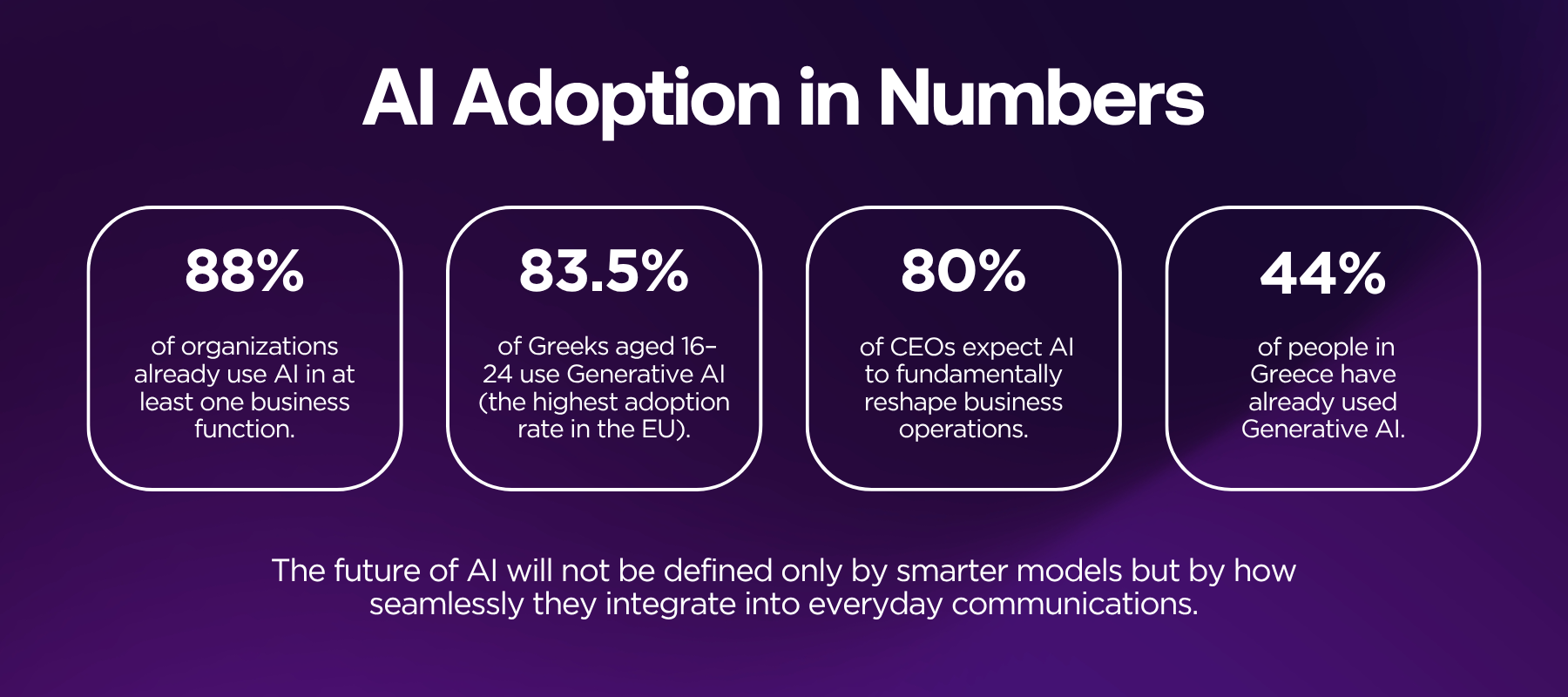
According to recent research, 88% of organizations now use AI in at least one business function, up from 78% the previous year. Yet the same research also reveals that most organizations have not successfully moved beyond experimentation into enterprise-scale deployment. This perfectly reflects where the market stands today.
AI has become part of our daily lives. What has not yet become is a fully integrated layer within enterprise infrastructure, operational workflows, and mission-critical communication systems.
The real challenge is no longer whether an organization is "using AI." The challenge is whether it can deploy AI securely and reliably in real-world environments. This becomes even more critical when discussing voice-enabled services.
An AI voice model may perform impressively in a demonstration. However, once it is expected to serve thousands (or even millions) of citizens, customers, or visitors in real time, success depends far more than the AI model itself.
It depends on latency, availability, voice quality, telecommunications routing, cloud infrastructure, APIs, security, system integrations, and interoperability with existing enterprise platforms.
In other words, the next stage of AI will not be defined solely by how intelligent the models become. It will be defined by how reliably they operate in real-world services.
Read why VoIP infrastructure is critical for AI Voice services here.
Why Voice AI Is Transforming Customer Service
Voice AI is becoming increasingly important because it sits at the intersection of three major business priorities:
Within call centers, for example, Voice AI has the potential to fundamentally transform customer interactions. Traditional IVRs built around "Press 1, Press 2" menus are gradually giving way to natural conversations. Instead of knowing which department to select, customers can simply describe what they need.
The system can understand the request, retrieve information from connected business systems, trigger workflows, update CRM platforms, or intelligently route the call to the most appropriate agent while preserving the conversation context.
This is not limited to large enterprises. It applies to virtually every organization handling significant customer communications, including retail, e-commerce, tourism, healthcare, logistics, banking, insurance, utilities, and professional services.
Greece as a Real-World AI Adoption Case
Another particularly interesting development is Greece's strong adoption of Generative AI.
According to data published by ai.gov.gr based on Eurostat research, approximately 44% of people in Greece have already used Generative AI tools, exceeding the European Union average.
Among people aged 16–24, AI adoption reaches 83.5%, currently the highest rate across the EU.
These figures demonstrate that AI is no longer an emerging technology. It has already become part of everyday digital life, especially for younger generations.
The real challenge, however, lies in transforming personal AI usage into meaningful business and institutional value. This is precisely why initiatives such as partnership with Eleven Labs matter. They are not simply about introducing another technology.
They represent the transition from individual AI usage to large-scale organizational adoption.
From Digital Self-Service to Conversational Experiences
Until recently, digital transformation largely focused on self-service. Users learned to complete forms, searched portals, submitted tickets, navigated applications, and independently located the information they needed.
Artificial intelligence is changing that model. The experience is shifting from self-service to conversational service. Users no longer need to understand where information is stored, or which process they should follow.
Instead, they can simply speak, ask questions, describe a problem, or explain what they need. This creates an entirely new generation of digital services where communication becomes faster, more natural, and highly personalized.
For businesses, this means customer service will no longer be confined to individual channels. Business telephony, live chat, messaging platforms, CRM systems, and workflow automation will increasingly converge into a unified communications ecosystem.
AI Requires Telecommunications Reliability
As Voice AI moves beyond demonstrations into production environments, the quality of the user experience depends heavily on the infrastructure supporting it.
In voice communications, even minor delays, packet loss, or quality degradation can significantly impact the conversation. Interactions must feel natural, immediate, and uninterrupted. This is why telecommunications infrastructure is no longer a secondary consideration.
It becomes an essential component of the AI experience itself. Organizations implementing AI voice agents, AI-powered contact centers, or intelligent voice automation require reliable connectivity to public telephone networks, secure call routing, cloud telephony, robust APIs, seamless integrations with enterprise applications, and infrastructure capable of supporting real-world operational demands.
This is where telecommunications and artificial intelligence converge. AI provides the intelligence behind the conversation. Telecommunications infrastructure makes that conversation possible.
What This Means for Businesses
While the partnership between ElevenLabs and the Greek Government focuses on the public sector, its broader implications extend far beyond government services.
Businesses seeking to remain competitive should move beyond simply "trying AI."
Instead, they should identify where AI can genuinely improve customer experience, increase operational efficiency, and accelerate service delivery.
In practical terms, this may include:
According to Gartner, 80% of CEOs expect artificial intelligence to fundamentally reshape their organizations' operational capabilities. The conversation is no longer about innovation alone. It is about how organizations will operate in the years ahead.
The Next Chapter of AI Will Be Voice-First, Omnichannel, and Fully Integrated
Artificial intelligence is no longer evolving as a standalone technology.
It is becoming a new operational layer built on top of existing infrastructure, applications, and communication channels. The next chapter of AI will be voice-first, because voice remains humanity's most natural interface.
It will be omnichannel, because customers think about experiences, not channels. And it will be deeply integrated, because AI delivers the greatest value when embedded directly into everyday business processes.
The collaboration between the Greek Government and ElevenLabs clearly reflects this direction: AI becoming part of public services, tourism, cultural heritage initiatives, and potentially other critical communication infrastructures.
Conclusion: From Technology to Experience
Artificial intelligence is moving beyond the era of demonstrations and entering the era of integration.
As AI becomes an integral part of everyday communication, the importance of reliable telecommunications infrastructure will only continue to grow. Because the future of artificial intelligence will not be determined solely by how intelligent AI models become.
It will be determined by how naturally, reliably, and seamlessly they connect people with the services they need.
As Voice AI continues to mature, the real challenge is no longer the AI model itself, but the infrastructure that enables it to operate reliably on scale. At modulus, we actively support this transition by integrating modern AI Voice platforms (including ElevenLabs) with enterprise telephony, cloud communications, and contact center environments, helping organizations bring conversational AI into real-world business operations.
Learn more about modulus AI Voice & Conversational Platform Integrations.