What is wholesale voice termination?
Wholesale voice termination is a carrier-level service used to route high-volume outbound voice traffic from telecommunications, VoIP, PBX or communications platform to the network serving the final called party. It typically relies on SIP and carrier interconnections to deliver calls to fixed, mobile or VoIP destinations.
A simplified call path might look like: PBX / Voice Platform → SIP → Wholesale Provider → Carrier Route → Destination Network → Recipient
International calls may pass through one or more interconnected carrier networks before reaching the fixed, mobile, or VoIP endpoint serving the recipient.
Wholesale termination is commonly used by:
- ITSPs and telecom carriers;
- VoIP resellers;
- high-volume call centers;
- CPaaS and communications platforms;
- large outbound operations;
- organizations with significant international voice traffic.
The modulus Wholesale Voice Termination service, for example, includes international, pan-European, domestic, and satellite call termination.
What is the difference between voice termination and voice origination?
Voice termination handles outbound calls, while voice origination brings inbound calls from the public telephone network into your communications environment.
| |
Voice Termination
|
Voice Origination
|
|
Direction
|
Outbound
|
Inbound
|
|
Main function
|
Sends calls to external destinations
|
Brings external calls into your system
|
|
Typical flow
|
PBX / platform → PSTN
|
PSTN → DID → PBX / platform
|
|
Common use case
|
International calling, outbound operations
|
Business numbers, hotlines, inbound support
|
Both functions may coexist in the same VoIP architecture, but they solve opposite sides of the calling journey.
For standard companies that primarily need business numbers, inbound and outbound calls, users, and PBX functionality, business VoIP telephony is usually the more relevant service layer. Wholesale termination becomes more important when traffic volumes, carrier routing, or international requirements become significantly more complex.
How do you choose a wholesale voice termination provider?
There is no single metric that identifies the best provider.
A useful telecom carrier selection process should combine technical, operational, and commercial criteria.
1. How good are the provider's routes?
Route quality should be one of the first things you evaluate.
Two providers can terminate calls to the same mobile operator but use very different carrier paths to reach it.
For example:
Route A:
Origin → Wholesale Provider → Destination Operator
Route B:
Origin → Wholesale Provider → Transit Carrier → Aggregator → Another Carrier → Destination Operator
A larger number of intermediary networks can introduce additional variables around latency, CLI handling, quality control, and troubleshooting.
Direct carrier relationships and Tier-1 access can give provider greater control over the route and make it easier to identify and resolve problems. However, direct does not automatically mean good and indirect does not automatically mean bad; real performance still needs to be measured.
Ask potential providers:
- Which of our priority destinations use direct routes?
- Which Tier-1 carriers do you interconnect with?
- Are multiple route classes available?
- How are routes selected?
- What happens when route quality deteriorates?
- Is alternative routing available automatically?
modulus currently reports 65 direct interconnections, more than 100 global partners, and connections with Tier-1 providers and major telecommunications companies worldwide.
2. Which metrics should you use to evaluate voice quality and reliability?
Statements such as “premium voice quality” are difficult to compare unless providers can support them with measurable data.
Several operational metrics are commonly useful.
ASR — Answer-Seizure Ratio
ASR measures the relationship between answered calls and total call attempts.
It can help identify unusual changes in call completion at route or destination level. However, ASR should always be interpreted in context because it is also influenced by unreachable numbers and whether recipients choose to answer.
ACD — Average Call Duration
ACD measures the average duration of successfully connected calls.
Unexpected changes in ACD may be useful as a diagnostic signal, particularly when comparing similar traffic over time.
PDD — Post-Dial Delay
PDD measures the delay between completion of dialling and the receipt of call-progress signalling such as ringing.
Very high or inconsistent PDD can point to routing or signalling issues.
MOS — Mean Opinion Score
MOS is used to express perceived voice quality. It is part of established ITU methodology for evaluating telephone transmission and speech quality.
Packet loss, latency, and jitter
In IP voice environments, packet loss, excessive latency, and packet-delay variation can directly affect conversational quality, causing gaps, delayed responses, or distorted audio.
The important point is not to evaluate one number in isolation.
ASR, ACD, PDD, audio-quality measurements, SIP responses, and actual traffic behaviour provide a much more useful picture when analysed together and by destination.
3. What is the difference between Least-Cost Routing and Quality-Based Routing?
A wholesale provider typically needs to balance cost and route performance.
Least-Cost Routing — LCR
Least-Cost Routing selects routes with a strong emphasis on finding the lowest available termination cost that satisfies the configured routing rules.
Quality-Based Routing — QBR
Quality-Based Routing gives greater weight to service-performance criteria and may select a more expensive route if it performs better.
Industry guidance highlights the value of combining route economics with quality monitoring rather than automatically routing every call through the cheapest available carrier.
For business-critical traffic, ask: “How do you balance rate and performance when selecting a route?”
rather than: “Do you always use the cheapest route?”
A low-cost route is useful only if it still meets the quality threshold required by the use case.
4. Why do direct carrier interconnections matter?
A direct interconnection can reduce the number of intermediary carrier relationships involved in delivering a call.
This may provide greater control over:
- route stability;
- troubleshooting;
- CLI transmission;
- latency;
- route monitoring;
- carrier escalation.
Again, direct interconnection is not a quality guarantee by itself.
It does, however, make one particularly important question easier to answer:
Who actually controls the route carrying my traffic?
For domestic traffic, modulus reports direct interconnections with all Greek fixed and mobile network operators. For international traffic, its wholesale service uses direct interconnections and relationships with Tier-1 and major telecom providers.
5. How important is CLI delivery?
CLI (Calling Line Identification) is the information that identifies the caller's telephone number.
Accurate CLI transmission can be particularly important for:
- customer support;
- outbound sales;
- customer callbacks;
- international corporate communications;
- call center operations.
When comparing voice termination services, ask:
- Is original CLI preserved?
- Which destinations support CLI?
- Are there destination-specific restrictions?
- Are separate CLI and non-CLI routes offered?
- How is caller identity monitored throughout the route?
The modulus Wholesale Voice Termination service currently states 100% CLI transmission through its direct interconnections in Greece, internationally, and for its satellite routes.
CLI integrity also matters beyond user experience. International voice traffic can be affected by practices such as call masking, refiling, spoofing, and bypass traffic, so businesses should understand how the provider controls routing and caller identity rather than viewing termination as a commodity defined only by price.
6. What does “global coverage” actually tell you?
A large destination list is useful, but it does not tell you whether the provider performs well in the destinations that matter most to your business.
Imagine your traffic looks like this:
|
Destination
|
Traffic Share
|
Business Importance
|
|
Germany Mobile
|
30%
|
Critical
|
|
UK Fixed
|
20%
|
High
|
|
Greece Mobile
|
15%
|
Critical
|
|
USA
|
10%
|
Medium
|
|
Other destinations
|
25%
|
Variable
|
In this example, strong performance in Germany, the UK, and Greece matters significantly more than having an impressive number of rarely used destinations on a coverage map.
Ask:
- Which routes do you use for our highest-volume countries?
- Are fixed and mobile networks covered?
- Which routes are direct?
- Are quality levels consistent between operators in the same country?
- Can you provide test traffic before migration?
modulus currently reports termination coverage across 195 countries, including international, pan-European, domestic, and satellite services.
Coverage should therefore be evaluated against your traffic profile, not only against a country count.
7. How reliable is the provider's network infrastructure?
Route quality is only one layer of reliability.
The wider network must also be designed to handle failures without turning an individual component problem into a complete service interruption.
Look for:
- redundant network architecture;
- alternative carrier paths;
- automatic or rapid failover;
- geographically diverse infrastructure;
- network monitoring;
- capacity planning;
- disaster recovery procedures;
- availability commitments or SLAs.
Wholesale VoIP selection guidance commonly identifies carrier redundancy, geographic diversity, monitoring, and SLA commitments as core reliability criteria.
The modulus wholesale service describes its network as fully redundant with 99.999% uptime for local, long-distance, and international calls.
For broader resilience requirements, businesses can also explore modulus' Business Continuity solutions.
8. Can the provider scale with your voice traffic?
A successful trial with a handful of calls does not prove that a provider can handle your production traffic.
Before selecting a provider, document:
- expected monthly minutes;
- concurrent calls;
- calls per second — CPS;
- traffic distribution by destination;
- peak periods;
- seasonal variation;
- expected growth.
Then ask:
What happens if our traffic doubles?
Are there CPS or concurrent-call limits?
Can capacity be increased without redesigning the interconnection?
How are sudden traffic spikes handled?
Scalability is particularly important for:
- call centers
- carriers and ITSPs
- resellers
- CPaaS platforms
- high-volume outbound systems
- seasonal or campaign-based traffic.
Wholesale VoIP providers are specifically designed around large-volume voice routing, but infrastructure, limits, and capacity models still vary substantially between vendors.
9. How should you compare wholesale voice termination pricing?
The cheapest rate deck does not necessarily result in the lowest real cost.
A proper pricing comparison should include:
|
Pricing Factor
|
What to Check
|
|
Rate per minute
|
Price by country, operator, and destination
|
|
Billing increment
|
1/1, 6/6, 60/60, etc.
|
|
Route class
|
Direct, premium, standard, or other provider-defined tiers
|
|
CLI
|
Whether the route supports the required CLI behaviour
|
|
Origin
|
Whether rates vary by calling-country origin
|
|
Minimum commitment
|
Monthly spend or traffic requirement
|
|
Volume tiers
|
Discounts at higher traffic volumes
|
|
Rate changes
|
Notice period and update process
|
|
Additional charges
|
Setup, regulatory, connection, or other fees
|
Billing increments can make a meaningful difference.
For example: 1/1 means billing can occur in one-second increments. 60/60 may mean that even a very short, completed call is charged as a full minute.
For traffic profiles containing many short calls, identical per-minute rates can therefore produce very different invoices.
The modulus wholesale service states that its pricing provides transparency according to the country of origin.
The useful comparison is therefore: effective traffic cost + route quality + billing model
rather than only: headline cost per minute.
10. Why does pricing transparency matter?
A provider should be able to explain:
- what route or route class you are buying;
- how it is billed;
- how origin-based pricing works;
- when rates can change;
- what additional charges may apply;
- whether there are minimum commitments.
Wholesale-provider guidance consistently identifies transparent commercial terms as an important part of provider selection because hidden fees, minimums, or unclear billing assumptions can distort apparently attractive rate cards.
For an IT or procurement team, a much stronger question than: “What is your Germany rate?”
is: “What is the rate, for which route class, for which origin, with what billing increment and under what commercial conditions?”
11. How important is SIP interoperability?
Wholesale termination must work with the communications infrastructure already used by the organisation.
That might include:
- 3CX
- FreePBX
- Asterisk
- Cisco
- an SBC
- a contact center
- a CPaaS platform
- an AI Voice platform
- a custom softswitch.
Important areas to test include:
- SIP signalling
- IP-based authentication
- codec compatibility
- RTP/media handling
- DTMF
- number formatting
- failover IPs
- SIP response handling.
Wholesale provider guidance recommends interoperability testing because signalling, codec, and configuration differences can create call-setup or voice-quality issues even when both sides technically support SIP.
For PBX environments, the modulus PBX configuration guides include technical resources for connecting supported telephone systems to its VoIP infrastructure.
modulus also offers business VoIP and SIP connectivity for business communication environments.
12. How important is technical support in wholesale voice?
Wholesale voice problems are often routing or network problems, not ordinary customer-service requests.
A route may be operational overall while still showing:
- poor performance for one prefix
- unusually high PDD
- one-way audio
- unexpected SIP responses
- incorrect CLI
- intermittent call failures
- destination-specific quality degradation.
This is why support capabilities need to be evaluated at a technical level. Ask:
- Is technical support available 24/7?
- Is there a Network Operations Center or equivalent escalation path?
- Who investigates route degradation?
- Can alternative routing be applied quickly?
- Can your teams exchange SIP traces and call examples?
- Are CDRs available?
- Are incident updates provided?
- Is there an account or technical contact for escalations?
For ITSP and WISP partners, modulus provides carrier-level call termination through its telecommunications infrastructure and positions technical support and reliability as part of the partnership model.
Businesses evaluating this model can explore the modulus ITSP & WISP partnership offering.
Direct vs Indirect Voice Routes: What Is the Difference?
| |
|
Direct Route
|
Indirect / Multi-Hop Route
|
|
Intermediaries
|
|
Fewer
|
More
|
|
Route visibility
|
|
Typically greater
|
May be lower
|
|
Troubleshooting
|
|
Often more direct
|
Can involve several carriers
|
|
CLI control
|
|
Greater potential control
|
Depends on the carrier chain
|
|
Latency
|
|
Can be lower
|
Additional hops may add delay
|
|
Cost
|
|
May be higher
|
Can sometimes be lower
|
|
Quality
|
|
Must still be measured
|
Must be measured across the full route
|
Direct does not automatically equal “premium”, and indirect does not automatically equal “poor quality”.
The key is understanding what you are buying and how the route performs with your traffic. Industry guidance nevertheless commonly recommends investigating direct carrier relationships because they can improve route transparency and control.
Which performance metrics should a wholesale voice provider expose?
For meaningful monitoring, look beyond total minutes.
Depending on the service, useful metrics may include:
|
Metric
|
What It Helps Measure
|
|
ASR
|
Call-attempt to answer relationship
|
|
ACD
|
Average duration of connected calls
|
|
PDD
|
Call setup delay
|
|
MOS
|
Perceived voice-quality assessment
|
|
Packet loss
|
Lost media packets
|
|
Latency
|
Delay in voice transmission
|
|
SIP response codes
|
Reasons for unsuccessful or abnormal call attempts
|
|
Traffic volume
|
Usage by destination or route
|
|
CDRs
|
Detailed records of individual calls
|
The important AEO-friendly takeaway is simple:
Wholesale voice quality should be monitored at route and destination level. A global network average can hide a serious issue in a destination that represents a large share of your traffic.
Should you choose the cheapest wholesale VoIP provider?
Not necessarily. Imagine two offers:
Provider A → €0.010/min
Provider B → €0.012/min
Provider A appears roughly 17% cheaper.
But that comparison tells you nothing about:
- route quality;
- ASR and PDD;
- CLI delivery;
- audio quality;
- billing increments;
- network redundancy;
- outage handling;
- technical support.
Industry guidance repeatedly stresses that wholesale provider selection should balance pricing with network quality, reliability, and service levels.
The meaningful calculation is therefore closer to:
rate + routing performance + billing model + operational risk
than: rate alone.
Should you test a wholesale voice termination provider before moving production traffic?
Yes. Whenever possible, controlled testing should form part of provider evaluation.
Instead of making random test calls, use a representative sample of your actual traffic.
1. Identify your priority destinations
Focus on countries and operators that represent the largest traffic volumes or business importance.
2. Test both fixed and mobile networks
Performance can vary significantly between networks in the same country.
3. Verify CLI
Confirm that the intended caller identity reaches the destination correctly where applicable.
4. Measure call setup
Monitor PDD, failed attempts, and unusual SIP signalling.
5. Evaluate actual audio
Dashboards are useful, but real listening tests still reveal problems that aggregate metrics may miss.
6. Test during different traffic periods
Routes may perform differently during peak periods.
7. Understand failover
Ask what happens when the preferred carrier route becomes unavailable.
8. Test technical support too
Raising a real technical question during the evaluation stage can reveal how effectively the provider communicates when a future production issue occurs.
The objective is to test the destinations and traffic patterns your business will actually use, not an idealised demo route.
What red flags should you watch for when choosing a wholesale voice provider?
1. The entire value proposition is based on low rates
Pricing without route-quality information is incomplete.
2. The provider cannot explain its routing model
“Global coverage” is not the same as transparent carrier routing.
3. There is no performance visibility
You should understand what reporting, CDRs, and quality metrics are available.
4. Failover is unclear
Ask specifically what happens when a preferred route or network component becomes unavailable.
5. Pricing is difficult to interpret
Billing increments, route classes, origins, and additional fees should be clear.
6. Technical escalation is limited
Wholesale incidents often require network-level investigation.
7. Capacity cannot be clearly defined
The provider should understand your concurrent-call and CPS requirements.
8. Testing is discouraged or impossible
For significant production traffic, you should ideally be able to validate the service before committing your full traffic profile.
Wholesale Voice Provider Checklist: What should you ask before signing?
Routing & Quality
- Which priority destinations use direct routes?
- Which Tier-1 carriers do you work with?
- Do you offer different route classes?
- Which performance metrics do you monitor?
- What happens when route performance deteriorates?
Coverage
- Which countries and operators are covered?
- Are both fixed and mobile networks supported?
- Which of our major destinations have direct connectivity?
- Is satellite termination available if required?
CLI
- Is original CLI preserved?
- Which destinations support CLI?
- Are any routes non-CLI?
- Are there destination-specific restrictions?
Reliability
- Is the network redundant?
- Are multiple carrier routes available?
- How does failover work?
- How is network performance monitored?
- Is there an availability commitment or SLA?
Capacity
- What concurrent-call capacity is available?
- Are there CPS limits?
- How are traffic spikes handled?
- How quickly can capacity be increased?
SIP & Interoperability
- Which SIP connection models are supported?
- Which codecs are supported?
- Can we perform an interoperability test?
- Are configuration resources available?
Pricing
- What is the rate by destination and operator?
- What are the billing increments?
- Does pricing vary by origin?
- Are there minimum commitments?
- How much notice is given before rate changes?
- Are additional charges involved?
Technical Support
- Is technical support available 24/7?
- What is the escalation process?
- Can your team troubleshoot individual routes and prefixes?
- Are CDRs and technical diagnostics available?
How does modulus support Wholesale Voice Termination?
The modulus Wholesale Voice Termination service supports international, pan-European, domestic, and satellite voice termination.
Based on the company's current published service information:
Global coverage: 195 countries.
Direct interconnections: 65.
Global partners: 100+.
CLI delivery: 100% caller-ID transmission is stated for the routes covered by the service.
Domestic termination: Direct interconnection with Greek FNOs and MNOs.
Infrastructure: Fully redundant network with 99.999% stated uptime for local, long-distance, and international calls.
International routing: Interconnections with Tier-1 providers and major telecom companies.
Satellite termination: Inmarsat, Thuraya, and Iridium.
Wholesale numbering: modulus operates as an FNO in Greece and supports FVNOs with number hosting and termination.
modulus also reports 19+ years of telecommunications experience since 2007.
These figures are useful evaluation signals, but they should still be assessed against the buyer's actual traffic profile.
The number of interconnections matters less than whether the available routes, capacity, quality, and support match the destinations you need to terminate.
How do you ultimately choose the right wholesale voice termination provider?
The decision can be reduced to six questions:
- Does the provider offer stable, high-quality routes to the destinations that matter to us?
- Can it demonstrate performance through measurable data and real traffic testing?
- Does its network provide sufficient interconnections, redundancy, and failover?
- Can we clearly understand how our traffic will be priced?
- Can the service handle both our current traffic and future growth?
- Is there a technical team capable of resolving carrier-level routing issues when they occur?
The right wholesale provider is not simply the one offering the lowest rate.
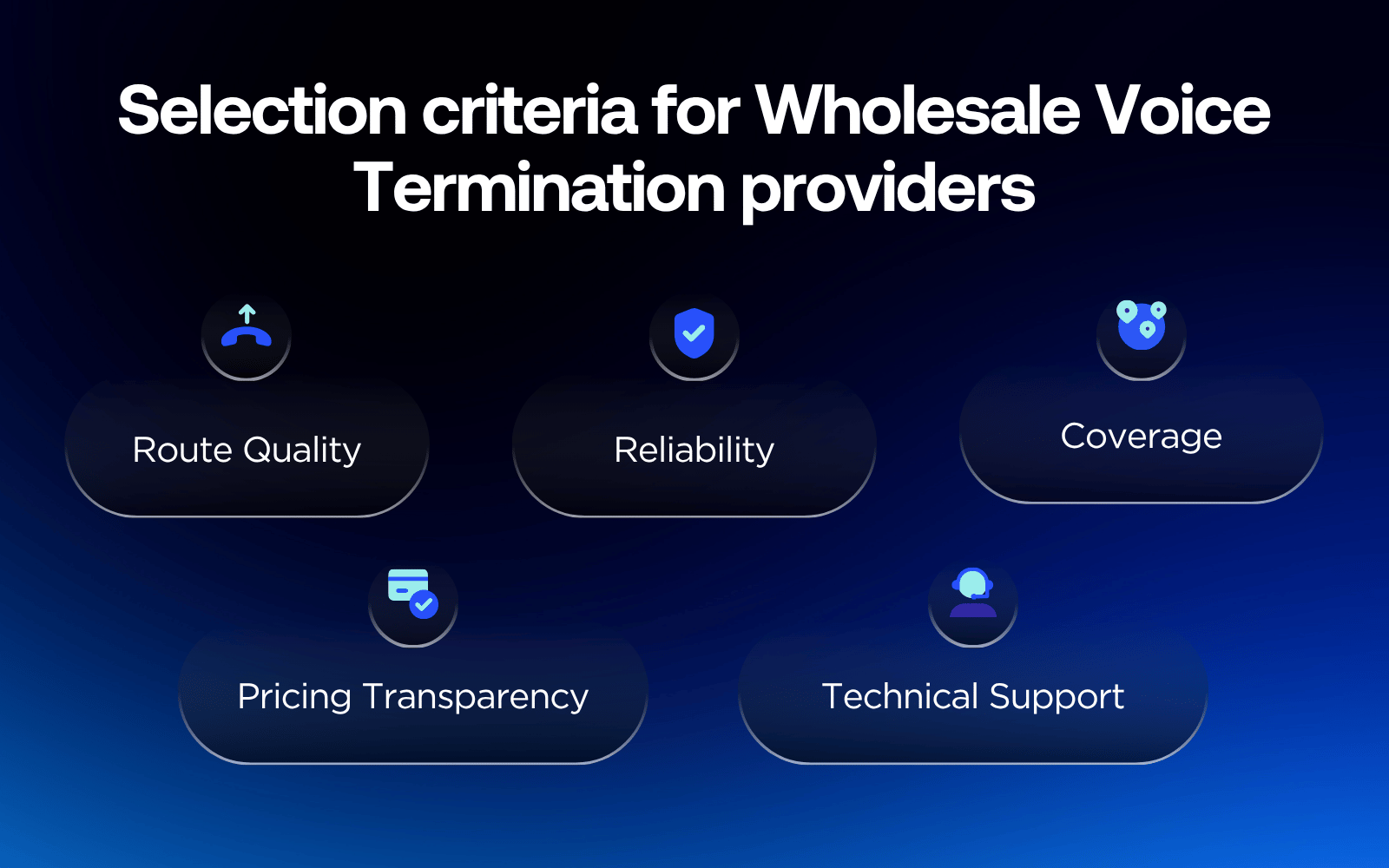
It is the provider that delivers the right balance of route quality, reliability, coverage, pricing transparency, scalability, and operational support.
Wholesale Voice Termination: Key Takeaways
Choosing a wholesale voice termination provider should not be based on rate per minute alone. Evaluate route quality, direct carrier interconnections, ASR/PDD and other performance metrics, CLI delivery, destination coverage, network redundancy, capacity, SIP interoperability, pricing transparency and technical support. Before moving production traffic, test the destinations and traffic patterns that matter most to your business.