What Is an AI Voice Agent?
An AI voice agent is an artificial intelligence system that can make or receive phone calls, understand natural speech, and respond to callers in real time. Through integrations with CRM systems, APIs and business applications, it can also retrieve information, trigger workflows, complete predefined actions and transfer calls to human agents when needed.
Unlike a traditional IVR, where customers follow predefined menus such as “press 1 for Sales” or “press 2 for Support,” an AI call agent can understand spoken requests and adapt the conversation accordingly.
For example, a customer might simply say: “I need to move tomorrow’s appointment to the afternoon.”
A properly designed AI voice agent can identify the customer’s intent, collect any information it needs, check availability in the relevant system, and potentially complete the change within the same conversation.
This is one of the key capabilities of modern conversational AI. Rather than simply reproducing predefined answers, it can use context, follow workflows, interact with external systems, and where permissions allow take specific actions.
How Do AI Voice Agents Work?
Behind what sounds like a simple phone conversation, several technology layers work together in real time.
At a high level, an AI voice interaction typically involves:
-
Speech recognition: The caller’s voice is converted into information the AI system can process.
-
Conversational AI: The system interprets the request, uses the available context, and determines the appropriate response or next action.
-
Business integrations: When required, the AI interacts with CRM, help desk, ERP, booking, or other business applications.
-
Voice synthesis: The generated response is converted back into natural-sounding speech.
-
Telephony infrastructure: The conversation is connected to the real phone network so that the AI can make and receive actual calls.
That final layer is critical.
For an AI agent to use real phone numbers and support inbound or outbound calling, it needs to connect to suitable business VoIP infrastructure. Explore modulus VoIP Telephony
The same applies to business data. When telephony connects with CRM and customer communication platforms, an AI agent can become part of a much broader operational workflow rather than functioning as an isolated voice interface. Explore VoIP integrations with CRM and customer communication platforms
An agent may therefore go beyond saying, “Your order is on its way.”
Depending on the AI platform, integrations, workflows, and permissions in place, it may be able to look up an order, create a support ticket, schedule an appointment, update a record, or transfer the caller to the appropriate team together with the context already collected during the conversation.
What Can AI Voice Agents Automate in Customer Service?
The real value of customer service automation does not necessarily come from automating every customer conversation.
It comes from identifying interactions that are repetitive, predictable, and suitable for structured automation.
Depending on the use case and available integrations, AI voice agents can support tasks such as:
-
answering frequently asked questions;
-
providing order, booking, shipment, or request status updates;
-
scheduling, confirming, or rescheduling appointments;
-
collecting basic caller information;
-
identifying call intent;
-
intelligent call routing;
-
transferring calls to the appropriate representative or department;
-
after-hours customer support;
-
overflow call handling when human teams are busy;
-
outbound reminders and notifications;
-
predefined workflows involving other business systems.
These possibilities expand further when telephony is connected with the wider communication ecosystem of a business. Explore VoIP integrations with communication and collaboration platforms
The result is not necessarily a fully automated contact center. In many cases, the more useful model is a hybrid support environment in which AI handles the right interactions and human agents focus on the conversations where their expertise adds the most value.
How Fast Is AI Adoption Growing in Customer Service?
AI agents are already moving beyond proof-of-concept deployments.
According to Salesforce’s State of Service: AI Agents Edition, based on a survey of 3,075 customer service professionals worldwide, adoption of agentic AI among customer service organizations increased from 39% in 2025 to 66% in 2026 a 1.7x increase in one year.
The research also found that:
70% of customer service organizations using AI agents report measurable value within 60 days of deployment.
And when respondents were asked which KPI had improved the most following AI agent deployment, customer satisfaction ranked first, ahead of service representative productivity, average handle time, customer retention, and first-response time.
These figures refer to AI service agents more broadly, rather than voice agents alone. However, they illustrate how quickly AI automation is moving from experimentation into real customer service workflows.
AI vs. Human Agents: What Should Businesses Actually Automate?
Discussions about AI customer service often jump quickly to one question: “Can AI replace human customer service agents?”
For most businesses, that is not the most useful question.
A better one is: “Which parts of our customer service process should be automated?”
A customer calling for the fifth time that day to check whether an order has shipped does not necessarily need to wait in a queue for a human representative.
The same may apply to a simple appointment change, an availability request, or the initial collection of information before a support case is routed.
A complex dispute, unusual technical issues, sensitive complaint, negotiation, or situation requiring judgment may be entirely different.
This is why voice-based customer support does not have to be designed around an “AI versus humans” model.
It can operate as a hybrid environment in which AI handles suitable repetitive interactions while human agents take over when judgment, flexibility, expertise, or more personal approach is required.
Gartner predicts that by 2029, agentic AI could autonomously resolve as many as 80% of common customer service issues, potentially reducing operational costs by 30%. Importantly, this is a Gartner forecast for 2029 not a description of current automation levels.
Why Telephony Infrastructure Matters for AI Voice Agents
An AI voice agent may have an advanced language model, highly natural voice synthesis, and access to the right business data.
But the quality of a real voice interaction depends much more than the intelligence of the model.
Research into enterprise Voice AI supports this.
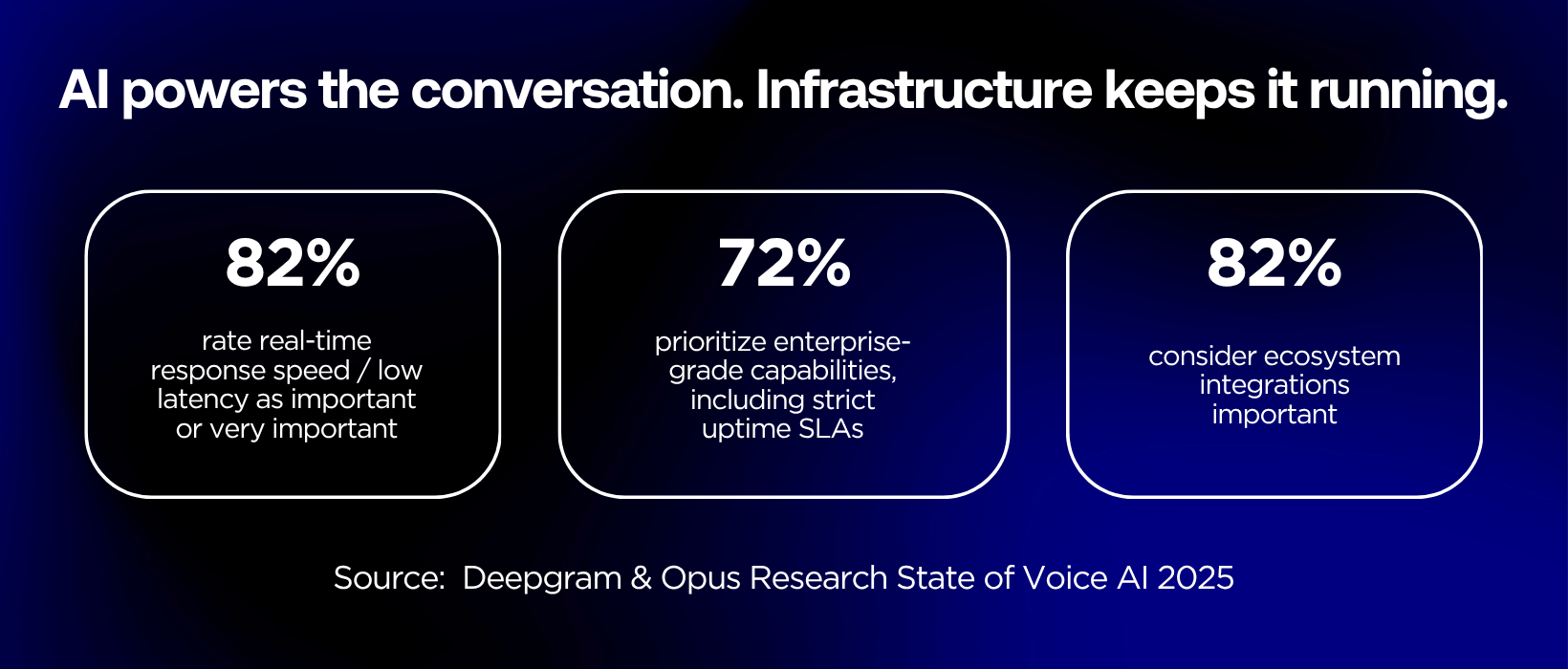
In the State of Voice AI 2025, conducted by Deepgram in partnership with Opus Research across 400 business leaders, 82% of respondents rated real-time response speed and low latency as important or very important when evaluating Voice AI technology.
Meanwhile, 72% placed similar importance on enterprise-grade capabilities such as strict uptime SLAs.
That matters because in a real telephone conversation, latency and service availability are not determined by the AI model alone.
They are influenced by the full execution chain from speech processing and connectivity to SIP, routing, real-time media, and the telephony infrastructure carrying the call.
Consumer researches points in the same direction. In Telnyx’s 2026 State of Voice AI Consumer Insights Panel, more than four in five respondents said that when a voice system feels slow or laggy during a call, they are more likely to hang up or abandon interaction
If communication with an AI voice agent is delayed, unstable, incorrectly routed, or unable to transition successfully to a human representative, the customer experience still suffers regardless of how capable the underlying AI model is.
This is one of the most important differences between an impressive AI voice demo and a production-ready AI voice service.
1. Connection to the Public Telephone Network
An AI voice agent first needs the ability to make and receive real calls.
Through the right AI Voice and Conversational Platform integration, AI applications can connect to PSTN calling, real telephone numbers, and inbound and outbound voice traffic. Explore AI Voice and Conversational Platform integrations
Without that connectivity, an AI model may be able to generate a conversation but it is not yet functioning as a real business telephony channel.
2. SIP Trunking and Call Routing
SIP trunking is one of the core technologies used to exchange telephone calls between communication applications, AI platforms, business phone systems, and telecommunications networks over IP.
Routing is just as important.
Businesses need to determine:
-
which calls should reach the AI voice agent;
-
which calls should bypass automation;
-
when a conversation should be transferred to a human;
-
which team should receive the call;
-
what should happen if the preferred destination is unavailable.
Platforms such as Retell AI, ElevenLabs, AudioCodes LiveHub, Autocalls.ai, and LiveKit can be connected to modulus’ VoIP environment for real-world AI voice use cases through SIP, PSTN connectivity, routing, and real-time audio infrastructure. See supported AI Voice platform integrations
3. Latency and Conversational Quality
In a text chatbot, a short delay may go largely unnoticed.
In a voice conversation, it is far more obvious.
Natural conversation depends on rhythm and turn-taking. As end-to-end latency increases, interactions can begin to feel awkward, with pauses, overlapping speech, or the sense that the system is struggling to keep up.
This means the performance of an AI voice agent depends not only on how quickly the model generates a response, but also on the surrounding real-time audio and telephony infrastructure.
For Voice AI, responsiveness is not simply a UX enhancement. It is part of the service itself.
4. Call Transfer and Human Handoff
Effective AI customer service automation also needs to know when automation should stop.
A production-ready AI voice workflow should have clear escalation rules for:
The ability to transfer a call to a human representative is therefore a core part of the customer journey.
Ideally, that transition should not force the customer to explain everything again.
The context collected during the AI interaction can be passed into the next stage of the workflow so that the human agent understands why the customer is calling and what has already happened.
5. Availability, Redundancy, and Failover
If an AI agent is designed to offer 24/7 customer service, the infrastructure supporting it also needs to be designed for continuous operation.
If one component fails, there should be a clear fallback path.
An AI voice workflow is not a single standalone system. It may depend on:
Reliability must therefore be considered end to end.
6. Scalability and Concurrent Calls
A successful pilot with a small number of calls does not automatically mean that the same architecture can handle production traffic.
The real question is: What happens when 10, 100, or significantly more calls arrive at the same time?
For businesses with high call volumes, seasonal peaks, support queues, or outbound calling campaigns, infrastructure must be able to scale without sacrificing call quality or service availability.
In other words: The quality of an AI voice agent depends on more than the AI model. It depends on the entire infrastructure behind the call.
From AI Voice Demo to Production-Ready Customer Service
For an SME owner or IT manager evaluating automated customer interactions, choosing an AI platform is only one part of the architecture. Before moving into production, businesses should answer several practical questions.
What customer service use case are we trying to automate?
A clearly defined and repetitive workflow is usually a better starting point than trying to automate an entire customer service operation at once.
Which calls will the AI voice agent handle?
Inbound calls, outbound calls, or both?
What data does the agent need?
Does it need access to a CRM, help desk, booking platform, ERP, order management system, or another business application?
How will it connect to business telephony?
Which phone numbers will be used? How will calls enter and leave the AI platform? How will routing work?
When should the conversation escalate to a human?
Escalation criteria should be defined before deployment rather than improvised after problems appear.
How many concurrent calls must architecture support?
A use case designed for occasional inbound support has different infrastructure requirements from a high-volume outbound automation campaign.
What happens when a component fails?
Fallback scenarios should form part of the original architecture.
Which KPIs will determine whether the deployment is successful?
Depending on the use case, relevant metrics could include:
-
resolution rate;
-
containment rate;
-
transfer rate;
-
average handling time;
-
first-call resolution;
-
customer satisfaction;
-
cost per interaction;
-
call completion rate.
AI can automate the conversation.
The overall customer service architecture determines whether that automation works reliably in practice.
In practice, a production-ready AI voice deployment should be evaluated end to end, from latency and audio quality to SIP routing, APIs, integrations, human handoff and failover. A successful pilot does not automatically mean the same architecture will remain reliable under real production traffic.
What Does the EU AI Act Mean for AI Voice Agents in 2026?
The rapid adoption of AI voice agents is also accompanied by clearer transparency requirements in the European Union.
The transparency obligations under Article 50 of the EU AI Act apply from 2 August 2026.
Among other requirements, providers of AI systems designed to interact directly with individuals must ensure that people are informed that they are interacting with an AI system, unless this is already obvious from the circumstances.
European Commission guidance also clarifies expectations around directly interactive AI systems and the transparency measures providers and deployers should consider.
For an AI voice customer service project, this means the user experience is not only about how natural the voice sounds.
Businesses also need to consider:
The objective should not be to make AI indistinguishable from a human at all costs.
It should be to create an experience that is useful, transparent, reliable, and appropriately automated.
How Should a Business Start an AI Voice Project?
The first question may not be:
“Which AI voice agent should we choose?”
A better starting point is:
“What should happen when a customer calls us?”
That question immediately brings the conversation back to the customer journey.
-
Which requests can be automated?
-
What information does the AI need?
-
Which business systems need to be connected?
-
Which calls should eventually reach a human?
-
What context should be transferred with them?
-
How should the service behave outside business hours?
-
What happens when the AI, an API, or another component is unavailable?
Once these questions have been answered, there is another one that is just as important:
What telephony infrastructure will support all of this?
AI Voice at modulus: Start With the Connection to Real Telephony
At modulus, the AI Voice conversation starts at exactly this point. Discover modulus business communications
The discussion is not limited to which AI model or voice platform a business wants to use. It starts with how technology can become a real, reliable business telephony channel.
-
How will the AI agent make and receive PSTN calls?
-
How will it connect through SIP?
-
How will it use real local or international phone numbers?
-
How will calls be routed?
-
How will transfers to human agents work?
-
What happens if one part of the service becomes unavailable?
-
And what infrastructure is required as concurrent call volumes begin to grow?
Through modulus’ AI Voice and Conversational Platform Integrations, solutions such as ElevenLabs, AudioCodes LiveHub, Retell AI, Autocalls.ai, and LiveKit Cloud can connect to carrier-grade VoIP infrastructure and operate as real business communication channels. Explore modulus AI Voice integrations
The infrastructure supports capabilities including PSTN connectivity, local and international numbering, SIP trunking, real-time audio integration, call transfers, intelligent routing, high availability, redundancy, failover, and scalable AI voice workloads.
Because ultimately, however intelligent an AI voice agent may be, it still needs to pick up the phone.
And that is where our conversation begins.
AI Voice Agents for Customer Service: Key Takeaways
AI voice agents can automate repetitive customer service calls, understand natural speech, trigger business workflows and transfer conversations to human agents when needed. Reliable production deployments also require appropriate VoIP and SIP infrastructure, low latency, effective call routing, integrations, human handoff, redundancy and sufficient scalability for concurrent call volumes.