Key Takeaways
-
A call center focuses primarily on inbound and outbound voice communication.
-
A contact center combines voice with digital channels such as email, messaging, live chat and social media.
-
Having multiple communication channels does not automatically make a business a contact center; integration and customer context are what matter.
-
A call center may be the right choice for businesses where voice remains the main customer-service channel.
-
A contact center becomes more valuable when customers regularly move between channels.
-
VoIP can provide voice infrastructure for both, while connecting telephony with CRM, customer-service platforms, automation and AI.
What Is a Call Center?
A call center is a customer service or sales operation focused primarily on managing a high volume of inbound and outbound telephone calls.
Call centers are commonly used for:
An inbound call center receives calls from customers who need support, information or another service. An outbound call center initiates calls for purposes such as sales, reminders, surveys or follow-ups. Many businesses operate both.
Genesys defines a call center around the handling of customer telephone calls, including inbound, outbound and voice-based self-service interactions.
However, modern call centers do not necessarily depend on traditional physical phone infrastructure.
With cloud PBX and compatible call center solutions, businesses can manage inbound and outbound calls over IP networks while using features such as Interactive Voice Response (IVR), call queues, intelligent routing, call recording, performance reporting, and remote agent support. The available capabilities depend on the selected platform and its configuration.
The channel is still primarily voice, but the infrastructure behind it has become increasingly cloud-based and software-driven.
What Is a Contact Center?
A contact center is a customer-interaction operation that manages communication across multiple channels, usually including voice alongside email, live chat, messaging, social media and other digital touchpoints.
Typical contact center channels can include:
-
phone
-
email
-
live chat
-
SMS
-
messaging applications
-
social media
-
web forms
-
AI chatbots
-
AI Voice Agents
Genesys defines a contact center as a centralized environment for managing customer interactions across channels such as phone, email, chat and social media.
But offering several channels is only part of the picture. The greater value comes when those channels can share customer information, interaction history and workflows.
Imagine a customer who starts a conversation through live chat, receives additional information by email and later calls customer service.
In a disconnected environment, the customer may have to explain the issue again.
In an integrated contact center, the agent handling the call can potentially access the previous interactions and continue the conversation with context.
That is the important difference: continuity.
Call Center vs Contact Center: What Is the Difference?
The main difference between a call center and a contact center is their communication scope and the way customer interactions are managed.
| Feature |
Call Center |
Contact Center |
| Primary focus |
Voice calls |
Customer interactions across channels |
| Channels |
Mainly phone |
Phone, email, chat, messaging, social and more |
| Typical technology |
VoIP/PBX, IVR, queues, routing |
Voice + digital channels + CRM/customer data |
| Customer context |
Primarily call-related |
Can follow the customer across channels |
| Primary goal |
Efficient call handling |
Consistent customer experience |
| Automation |
IVR, routing, AI Voice, call workflows |
Voice and digital workflow automation |
| Best suited to |
Voice-heavy operations |
Multi-channel customer journeys |
More Channels Do Not Automatically Create a Contact Center
A company may offer phone, email, chat and social media and still operate each one independently.
If calls live in one system, emails in another, chat history somewhere else and customer records inside a separate CRM, employees still need to move between applications and customers may still need to repeat information.
That is multichannel communication.
The shift toward a contact-center model happens when those interactions become connected around the customer.
Channel count is not a measure of customer-experience maturity.
Is a Contact Center Better Than a Call Center?
No. A contact center is not automatically better than a call center. The right choice depends on how customers communicate with the business.
Voice remains particularly valuable when interactions are:
For many businesses, a well-designed cloud call center can therefore be exactly the right solution.
A contact center becomes more relevant when customers frequently move between communication channels or when several departments need shared access to customer-interaction history.
The useful question is not: “Which technology is more advanced?”
It is: “How do our customers communicate with us, and how much context needs to follow them?”
Which One Does a Business Need?
A business usually needs a call center when its main operational challenge is managing calls. It needs a contact center when the challenge is managing the customer journey across multiple communication channels.
When Does a Business Need a Call Center?
A call center may be the better choice when:
-
most customer interactions happen by phone;
-
inbound call volume is high;
-
calls need to be distributed efficiently;
-
waiting times need to be reduced;
-
customers need to reach specific departments;
-
managers need visibility in call performance;
-
agents work remotely or across different locations.
For example, a medical appointment service receiving hundreds of calls each day may gain considerably more value from intelligent routing, queues and better call handling than from adding several new digital channels.
A cloud-based business phone system can address these requirements through features such as IVR, queues, routing and reporting.
When Does a Business Need a Contact Center?
A contact center may be more appropriate when:
-
customers regularly move between phone and digital channels;
-
teams need access to the same customer history;
-
CRM or help desk data is central to customer support;
-
interactions involve several departments;
-
automation needs to span multiple communication channels;
-
the company wants a more unified view of customer interactions.
This may apply to:
A Simple Call Center vs Contact Center Decision Rule
Choose a call center if the operational problem mainly calls.
Choose a contact center if the operational problem is the customer journey across channels.
Call Center vs Contact Center: A Practical Business Example
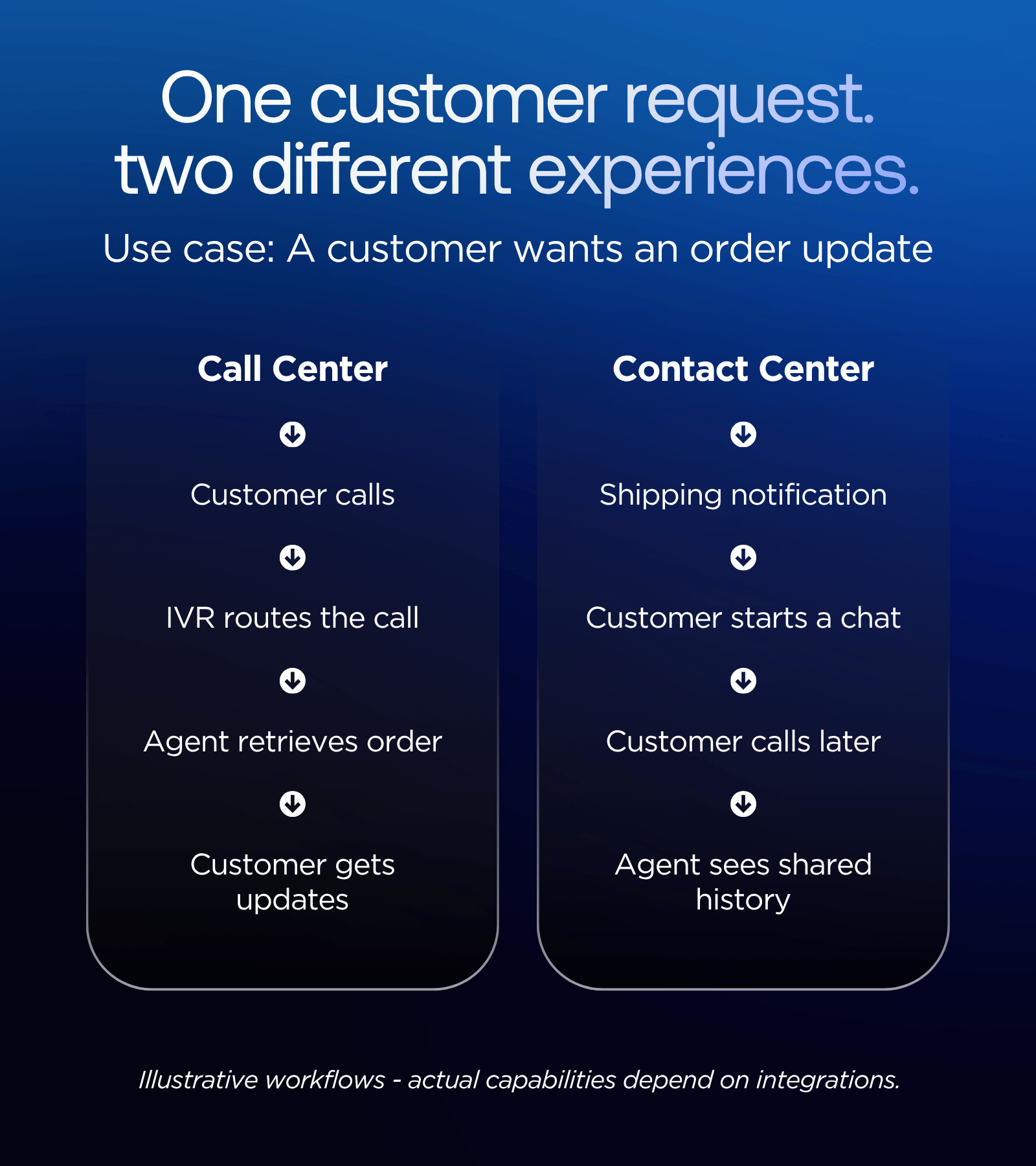
Consider an e-commerce customer who wants to know where an order is.
The Customer Journey in a Call Center
The customer calls the company. An IVR routes the call to customer service.An agent answers, retrieves the order information and gives the customer an update.
If phone is the company's primary support channel, this can be an efficient and effective customer journey.
The Customer Journey in a Contact Center
The customer may have already received an automated shipping notification. Later, they ask a question through live chat. After that, they call customer support.
If the systems are properly integrated, the agent may be able to access:
The important difference is not that the second business has more channels.
The difference is that those interactions can form one continuous customer journey.
Why Does Customer Context Matter?
Customer context matters because customers increasingly expect businesses to recognize previous interactions rather than treating every channel as the beginning of a new conversation.
That becomes particularly important as businesses introduce automation and AI into customer service.
Salesforce's State of Service research highlights the growing importance of connecting service data, channels and AI-driven customer interactions.
The principle extends beyond AI:
Every additional channel creates value only if it makes communication easier for the customer instead of becoming another disconnected system.
How Does VoIP Fit into Call Centers and Contact Centers?
VoIP provides the voice connectivity behind many modern call centers and contact centers, allowing business telephony to operate over IP networks rather than traditional telephone infrastructure.
How Is VoIP Used in a Call Center?
For a call center, VoIP can support:
How Is VoIP Used in a Contact Center?
In a contact center, voice becomes one component of a wider customer-communication ecosystem.
Through VoIP integrations with CRM and customer communication platforms, telephony can connect with systems used for customer service, sales and customer-data management.
Depending on the integration, an incoming call could:
-
identify the customer
-
connect the interaction with a CRM record
-
route the caller to the appropriate team
-
provide the agent with relevant customer information
-
log the interaction.
VoIP therefore does more than move calls over the internet.
It can act as the connectivity layer between voice communication and the wider customer-service technology stack.
Can CRM Integration Turn a Call Center Into a Contact Center?
CRM integration can move a call center closer to a contact-center model, but an integration alone does not automatically create one.
Connecting telephony with customer data allows agents to work with greater context and can reduce the need to switch between disconnected systems.
For example, integrating VoIP telephony with CRM and customer-service platforms can connect voice interactions with customer records and support workflows.
But a contact-center strategy involves more than connecting a telephone system to CRM.
Businesses also need to determine:
-
which channels customers should use
-
what customer information should follow them
-
how interactions should be routed
-
when automation should intervene
-
when a human should take over
-
what context should survive the handoff.
Technology enables continuity. Process design determines whether the customer experiences it.
How Is AI Changing Call Centers and Contact Centers?
AI can automate defined interactions in both call centers and contact centers, but its greatest value comes when it has access to the right context and can transfer conversations effectively when human support is required.
AI Voice Agents can support use cases including:
Digital AI agents can perform similar tasks through messaging and chat.
Salesforce's State of Service research also highlights the growing role of AI across customer-service workflows and the importance of connecting AI with service data.
This creates an important principle:
Automation should not become another communication silo.
AI Voice Agents can automate repetitive customer interactions, including order-status enquiries, appointment scheduling, and initial call routing. When a request requires human intervention, the interaction should be transferred to the appropriate agent along with relevant customer context and conversation history, where supported by the integrated systems. This helps maintain service continuity while allowing AI and human agents to work together effectively.
For businesses exploring this model, AI Voice platform integrations with VoIP can provide the voice connectivity required for AI agents to make and receive calls and interact with existing telephony environments.
Does Every Business Need an Omnichannel Contact Center?
No. Adding more communication channels can create additional complexity if a business does not have the processes, integrations or resources to manage them effectively.
Adding chat, social messaging, email and AI simply because competitors offer them can result in:
-
fragmented customer histories
-
duplicated work
-
inconsistent service
-
abandoned communication channels
-
more applications for agents to monitor
-
increased operational complexity.
A smaller organization with a well-designed call center can provide better customer experience than a company operating six disconnected communication channels.
The goal should therefore not be: “Be everywhere.” It should be: “Be available where customers need us, and make those interactions work together.”
Can a Business Start with a Call Center and Move to a Contact Center?
Yes. A business can begin with voice and gradually add integration, digital channels, automation and AI as its customer-service requirements evolve.
1. Build the Voice Foundation
Start with:
2. Connect Business Systems
Integrate the voice environment with relevant systems such as:
-
CRM
-
help desk
-
ERP
-
customer databases
3. Add the Channels Customers Actually Use
Introduce messaging, chat, email or other channels based on real customer behaviour rather than simply expanding channel count.
4. Introducing Automation
Use automation for repetitive routing, notifications, self-service and defined workflows.
5. Add Conversational AI Where It Solves a Defined Problem
Introduce AI Voice Agents or digital agents where automation can resolve a specific customer or operational need.
The advantage of flexible cloud infrastructure is that businesses do not necessarily need to design their complete future contact center on day one.
They can build around actual customer behavior and evolve over time.
What Metrics Should Call Centers and Contact Centers Track?
Call centers usually focus more heavily on voice-operation metrics, while contact centers also need to understand performance across channels and the wider customer journey.
Common Call Center Metrics
These may include:
-
average speed of answer
-
abandonment rate
-
average handling time
-
first-call resolution
-
service level
-
call volume
-
agent availability
Common Contact Center Metrics
These may also include:
- first-contact resolution across channels
- response time by channel
- customer satisfaction
- channel switching
- self-service resolution
- escalation rates
- conversation continuity
- AI-to-human handoff performance
The distinction is important.
A call can be handled efficiently while the overall customer journey is still frustrating.
Operational efficiency and customer effort are not always the same thing.
Call Center vs Contact Center: Which Is Better for Your Business?
Neither model is inherently better. A call center is usually the better fit when voice is the dominant customer-service channel and the main priority is handling calls efficiently.
A contact center is usually more appropriate when customers interact across multiple channels and the business needs customer context to follow those interactions.
Before choosing a solution, consider:
-
How do customers contact us today?
-
Which channels generate meaningful interaction volume?
-
How often do customers switch between channels?
-
Do agents have to search across several systems?
-
Does customer information follow the interaction?
-
Which requests could be automated?
-
Which interactions should remain human?
-
How might our communication needs change as the business grows?
Business needs should determine the technology not the other way around.
Call Center vs Contact Center: Key Takeaways
The difference between a call center and a contact center ultimately goes beyond phone calls versus digital communication.
-
Call centers primarily organize and optimize voice interactions.
-
Contact centers coordinate customer interactions across multiple channels.
-
Adding more channels does not automatically create an omnichannel customer experience.
-
The real differentiator is whether customer context follows the conversation.
-
Voice-heavy businesses may not need a full contact center.
-
Businesses with complex, multi-channel customer journeys benefit more from connected data and workflows.
-
VoIP telephony can provide the voice foundation for either model, while integrations connect telephony with CRM, customer-service platforms, messaging and AI.
The goal is not to create the most complex communication environment possible.
It is to remove friction between the customer, the conversation and the people or systems that can resolve the request.