What is VoIP number portability?
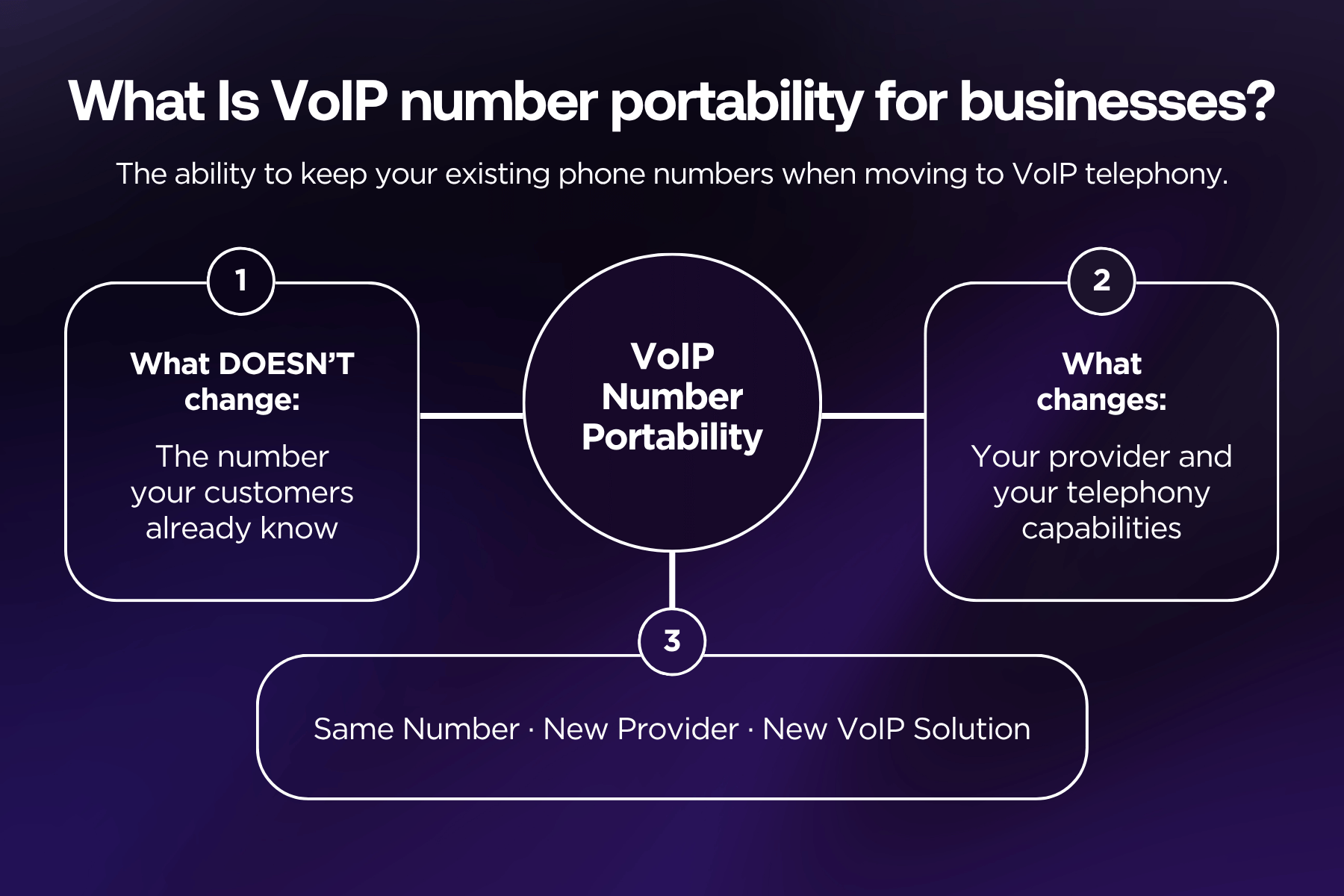
VoIP number portability is the process of transferring an existing telephone number from one telecommunications provider to another while keeping the number unchanged and continuing to use it with a VoIP service. In simple terms, the phone number stays the same while the provider and telephony infrastructure behind it change.
Number portability is not a feature exclusive to VoIP. It is the ability to retain a telephone number when changing providers, and it also applies when the new service operates over Voice over Internet Protocol (VoIP). EETT explicitly includes PSTN, ISDN and VoIP fixed numbers within its portability framework.
For business, this makes it possible to move to modern VoIP telephony without having to replace an established number.
Can a business keep its existing phone numbers when moving to VoIP?
Yes, in most cases. Keeping existing numbers often referred to as number retention is the core purpose of telephone number portability.
This matters because established business numbers may already appear across:
-
company websites and Google Business Profiles,
-
business cards and printed materials,
-
paid advertising campaigns,
-
CRM and ERP systems,
-
online directories,
-
email signatures,
-
contracts and corporate documents,
-
customer and supplier records.
An established telephone number can effectively become part of a company's business identity. Keeping it during migration reduces operational friction and avoids the need to inform customers, partners and suppliers of a new contact number.
Number portability is also far from an exceptional use case. According to official EETT portability statistics, 374,411 fixed telephone numbers were ported in Greece during 2025. Across fixed, mobile and non-geographic numbers, 1,096,729 numbers were ported during the year.
How does VoIP number porting work?
The VoIP number transfer process is initiated through the new provider rather than the existing one.
For businesses, the process typically includes the following steps.
1. Identify the numbers that need to be ported
The first step is to create an accurate inventory of the telephone numbers the business wants to retain.
For a small company, this may involve a single main business number. More complex environments may include multiple numbers, direct numbers for different departments, or numbers currently connected to different telephony services.
2. Choose the new VoIP provider and solution
The business selects its new telecommunications provider and determines how the numbers will be used after the migration.
For example, an existing number can be connected to a vPBX cloud phone system, enabling calls to be routed through extensions, IVRs, ring groups, queues, remote users and softphones.
3. Submit the number portability application
The portability request is submitted to the new provider, which forwards the request to the existing provider.
EETT states that the number portability application also serves as a request to terminate the corresponding services with the current provider.
Businesses moving their numbers to modulus can also consult the modulus Activation & Portability Forms guide for instructions on completing the required documentation correctly.
4. Verify subscriber and number details
The current provider checks whether the information contained in the portability request matches its subscriber records.
Accuracy is particularly important at this stage. Incorrect or inconsistent subscriber information can result in the request being rejected and subsequently resubmitted.
5. Schedule and activate the port
Once the request has been accepted, the number transfer is scheduled, and the number is activated on the new provider's network.
For business migration, the new VoIP environment should ideally already be configured before the porting date. This allows extensions, routing rules, IVRs and other functionality to be ready when the number moves to the new infrastructure.
What information is required for business number portability?
Exact documentation may vary depending on the provider and application process, but the subscriber details submitted for portability must match those registered with the existing provider.
For modulus business portability applications, the process includes information such as:
-
business or subscriber details,
-
details of the company's legal representative,
-
the existing telecommunications provider,
-
the phone number or numbers to be ported,
-
the required signature of the applicant or legal representative.
When numbers are currently held by different providers, modulus requires a separate portability application for each provider.
The same guide also stresses that number portability must be requested using the subscriber information registered with the donor provider.
Getting these details right from the beginning is one of the simplest ways to reduce avoidable delays.
How long does VoIP number portability take?
It is useful to distinguish between the regulatory porting timeline and the total time required for a business VoIP migration.
According to EETT, the existing provider must examine a portability request forwarded by the new provider within six working hours and accept it unless there is a valid reason for rejection. Once accepted, fixed and mobile number porting must be completed within one working day at the latest.
That does not mean an entire business VoIP migration takes only one day.
Before the number is ported, a company may also need to complete tasks such as:
-
designing the new phone system,
-
creating users and extensions,
-
configuring IVRs and call queues,
-
setting up IP phones or softphones,
-
configuring call routing,
-
connecting CRM or business applications where required,
-
testing inbound and outbound calls.
This is why number portability should be treated as one stage of a wider VoIP migration plan, rather than as the migration itself.
Why can a number portability request be rejected?
A portability application can be rejected when required information does not match the records of the existing provider or when the number does not meet the necessary conditions.
EETT lists specific grounds for rejection, including situations where the subscriber identification details do not match those held by the current provider, the number is not active, or the number belongs to a different subscriber.
For business applications, it is therefore worth confirming the registered company name, tax identification details and subscriber information before submitting the request.
The modulus portability guide also identifies common issues that can lead to a rejection or delay, including:
-
incorrect subscriber information,
-
missing or incorrect signatures,
-
details that do not match the current provider's records,
-
incorrect telephone numbers,
-
missing supporting documentation.
Are there limitations to VoIP number portability?
Yes. Phone number portability allows businesses to retain their numbers when switching providers, but certain regulatory, geographic and contractual conditions may still apply.
Geographic numbers
For fixed telephone numbers, EETT specifies that customers can retain their number when switching providers provided, they remain within the same geographical area. This applies to PSTN, ISDN and VoIP numbers.
It is important to distinguish this requirement from the location flexibility offered by VoIP itself.
Once a number is connected to a cloud phone system, employees may be able to access business telephony from different devices, branches or remote locations. This flexibility does not override the regulatory conditions governing geographic telephone numbers.
Existing contracts
Having a fixed-term agreement does not remove the right to request number portability.
However, porting a number does not eliminate contractual obligations that already exist. EETT notes that these may include early termination fees, outstanding bills or other obligations arising from the existing contract.
Businesses should therefore review both the technical requirements and the commercial terms of their existing service before planning a migration.
Is number portability the same as call forwarding?
No. Number portability and call forwarding are two different mechanisms.
| |
Number Portability
|
Call Forwarding
|
|
Does the number move to a new provider?
|
Yes
|
No
|
|
Does the customer-facing number remain the same?
|
Yes
|
Yes
|
|
Are calls handled by the new provider's infrastructure?
|
Yes
|
Not necessarily
|
|
Is it a permanent provider migration?
|
Yes
|
No
|
|
Can it be used during a VoIP migration?
|
Yes
|
Often as a temporary routing solution
|
With number portability, the telephone number itself is transferred to the new provider.
With call forwarding, the number remains with the existing provider, and incoming calls are simply redirected to another destination.
For a permanent transition to a new business VoIP provider, number portability therefore serves a fundamentally different purpose from basic call forwarding.
What changes after a business number is ported to VoIP?
From the customer's point of view, ideally very little.
They continue to dial the same business phone number they already know.
Behind the scenes, however, calls can now be managed through an entirely different communications environment.
Depending on the chosen VoIP solution, the ported number can be connected to:
-
IVR menus,
-
ring groups,
-
call queues,
-
business extensions,
-
desktop and mobile softphones,
-
remote users,
-
working hours and time conditions,
-
voicemail,
-
CRM and other business applications.
This allows a company to combine keeping existing numbers with a broader upgrade of its telephony infrastructure.
Businesses replacing legacy infrastructure can also explore the modulus guide to migrating from ISDN to VoIP, which covers infrastructure assessment, solution selection, number porting, configuration and go-live planning.
What should businesses check before starting number porting?
A short pre-porting audit can prevent many avoidable problems.
Before submitting a portability request, businesses should check:
-
Which phone numbers are currently in use? Identify main numbers, DIDs and numbers used by individual teams or departments.
-
Which provider currently holds each number? This becomes especially important when the telephony environment has evolved over time.
-
Who is the registered subscriber? Business and subscriber details should match the records held by the current provider.
-
Are there existing contractual commitments? Review possible early termination obligations.
-
Where is each number being used? Check websites, CRM systems, fax services, alerts and other business applications.
-
Is the new VoIP environment ready? Extensions, IVRs, queues and routing rules should ideally be configured before the port.
-
Is there a post-port testing plan? Inbound, outbound and internal calls should be tested after activation.
For businesses with multiple locations, different providers or complex numbering environments, documenting this information before migration can make the transition significantly easier.
Why is number portability important when migrating to VoIP?
Upgrading business telephony should not require customers to relearn how to contact the company.
Number portability allows an organization to change its: provider, infrastructure and telephony capabilities, while keeping the number its customers already know.
That continuity makes it easier to modernize business communications while reducing unnecessary disruption to customers, partners and internal processes.
Businesses considering modulus can transfer an existing phone number to the modulus network and use it with modern VoIP and cloud telephony services. The modulus VoIP service specifically supports number portability as part of its business telephony offering.
VoIP Number Portability: Key Takeaways
VoIP number portability allows a business to switch telecommunications providers and move to VoIP while keeping its existing phone numbers. The process is initiated through the new provider and depends on accurate subscriber information, preparation of the new VoIP environment and post-port testing. Geographic and contractual conditions may still apply, so number porting should be treated as one stage of a wider business VoIP migration.