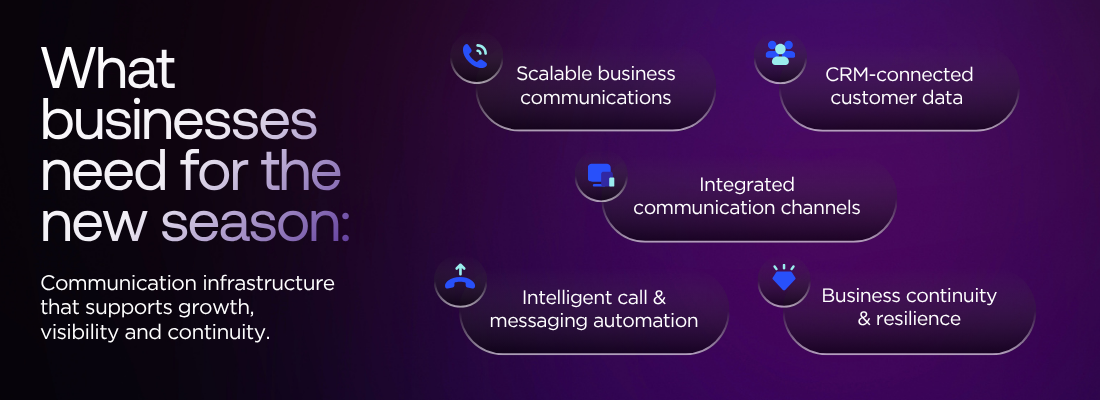
What Does It Really Mean for a Business to Be Ready for the New Season?
A business is ready for the new season when its people, systems and processes can support increased activity without creating delays, inconsistency or unnecessary complexity.
Readiness is not only about whether individual tools are working.
It is about whether:
-
information moves efficiently between teams,
-
customers receive a consistent level of service,
-
communication remains organized across every channel,
-
infrastructure can scale,
-
automation addresses real business needs,
-
management has access to reliable data,
-
the business can continue operating when events do not unfold according to plan.
Recent data shows that European businesses are steadily moving towards more cloud-based and connected operating models.
In 2025, 52.7% of EU enterprises used paid cloud computing services, compared with 45.3% in 2023. In the same year, 53% used specialised ERP, CRM or Business Intelligence software. However, only 28.51% used CRM software, indicating that the integration of customer data remains an area of development for many organisations.
Technology alone, however, does not constitute a strategy.
Value is created when systems are connected to the way the business operates and to the experience it wants to provide to its customers.
Can Your Communication Infrastructure Support Your Next Business Goals?
Business communication infrastructure should be designed not only around current requirements, but also around the volume, users and functions it may need to support during the next stage of growth.
Before the new season begins, many companies update their commercial plans, launch campaigns, recruit new employees or set more ambitious growth targets.
Their communication infrastructure, however, often remains designed around the requirements of the previous year.
A system that performs adequately during periods of lower activity may begin to create difficulties when:
-
inbound call volumes increase,
-
new users are added,
-
new departments are created,
-
additional branches open,
-
new services are launched,
-
reporting requirements become more demanding,
-
the team begins serving additional markets or countries.
The critical question is not simply whether the phone system works today.
It is whether it can follow the business to where it wants to be over the coming months.
Business VoIP telephony makes it easier to add numbers, users and simultaneous calls without depending exclusively on traditional telephone lines and local infrastructure. The service also supports centralised management through the mymodulus platform and can accommodate organisations ranging from growing SMEs to larger enterprise environments.
For companies that require more structured management of users, departments and inbound call flows, a cloud-based vPBX phone system can provide flexibility without requiring a physical server to be installed on the company’s premises.
The new season should not begin with the question:“How much more can our existing system handle?”
It should begin with: “Which infrastructure can support our next objective?”
Are Your Communication Channels Unified or Fragmented?
Communication channels are genuinely unified when information can follow the customer from one touchpoint to another without becoming lost between different applications, systems and teams.
A customer may begin their interaction with a phone call, continue through email, receive an update via SMS or Viber and return later with a new request.
From the customer’s perspective, all these interactions form part of one relationship with the same business.
From the company’s perspective, however, they may exist in different systems, be managed by different teams and produce separate communication histories.
Fragmentation creates problems such as:
-
customers being asked the same questions repeatedly,
-
delays when information is transferred,
-
different departments having different views of the same customer,
-
limited reporting capabilities,
-
additional manual steps,
-
uncertainty over who owns each request.
The right strategy does not necessarily require replacing every existing tool.
It involves creating a more unified ecosystem in which communication follows the customer rather than the boundaries of each platform.
VoIP integration with CRM and customer communication platforms can help transform CRM software into a more central communication hub, reducing the need for employees to switch continuously between different applications.
At the same time, Microsoft Teams Direct Routing and communication platform integrations allow businesses to bring collaboration and business telephony into a more unified working environment.
Integration is not simply a matter of convenience.
It reduces the distance between information and decision-making.
Does Customer Data Follow the Conversation?
Customer data follows the conversation when employees can access the relevant history, open requests and supporting information at the moment they communicate with the customer.
When a customer contacts a business, the value does not lie only in the content of that specific call.
It also lies in the context:
-
Who is the customer?
-
Have they contacted the company before?
-
Which products or services do they use?
-
Is there an open request?
-
Has a quotation already been sent?
-
Which department is responsible for the case?
-
What is the next expected action?
Without this context, even a fast response may result in a fragmented customer experience.
In 2025, 28.51% of EU enterprises used CRM software. Among large enterprises, the corresponding percentage reached 65.43%. The difference between company size categories illustrates how structured customer data management often becomes more important as operational complexity increases.
The beginning of the new season is an opportunity to examine whether:
-
telephone calls are connected with the CRM,
-
communication history is accessible to the appropriate teams,
-
requests are recorded consistently,
-
common follow-up standards have been defined,
-
reporting is based on consolidated data,
-
employees know which system serves as the main source of information.
Connecting telephony with CRM is not simply a technical integration.
It is the foundation for greater continuity throughout the customer relationship.
Does Automation Reduce Friction or Simply Add More Tools?
Automation creates real value when it removes a specific point of friction from the customer journey or the everyday workflow of a team.
Automation is now central to almost every discussion around productivity and customer experience.
In 2025, 20% of EU enterprises with at least 10 employees used AI technologies, compared with 13.5% in 2024. This increase is significant. It does not, however, mean that every automation automatically creates value.
Automation has strategic purpose when it:
-
reduces a repetitive manual step,
-
shortens customer waiting times,
-
directs a request to the right destination,
-
gives employees more time for complex tasks,
-
works within existing workflows,
-
provides a clear escalation path to a human representative,
-
can be evaluated against a real business result.
By contrast, adding another tool without assigning it a clear role may increase complexity.
Before investing in new automation, a business should answer one important question:
“Which specific point of friction are we trying to remove?”
AI Voice and conversational platform integrations can support use cases such as automated inbound and outbound call management.
To perform reliably in a real business environment, however, they require connectivity with the telephony infrastructure, appropriate routing and clear rules governing the transfer from AI to the human team. The modulus integration environment supports PSTN connectivity, SIP trunking, call transfers and scalable real-time voice workflows.
The new season does not necessarily require more tools.
It requires better-selected tools connected to specific business problems.
Can Your Team Grow Without Increasing Operational Complexity?
Scalable communication infrastructure allows a business to add users, departments, locations and functions without creating a different process for every new requirement.
Growth does not only mean acquiring more customers.
It may also mean:
In an unstructured environment, every addition creates another exception.
A new employee requires a different device, a new team handles calls in a different way and a new branch creates an entirely separate telephone environment.
The result is that the business grows while finding it increasingly difficult to operate as one unified organisation.
Scalability is not only the ability to add more users.
It is the ability to grow without repeatedly redesigning the way the business communicates.
A 3CX business phone system can support organisations that require advanced capabilities, CRM integrations, Microsoft Teams integration and more extensive configuration flexibility. modulus deployments include installation, configuration, VoIP connectivity, training and ongoing technical support.
For smaller or fast-growing teams that require a fully managed solution without complex on-site infrastructure, vPBX may provide a different approach.
The objective is not to select the solution with the longest list of features.
It is to choose a solution that can evolve alongside the structure and actual requirements of the business.
Is Operational Resilience Built into Your Business Planning?
Operational resilience is built into business planning when alternative procedures, responsibilities, communication channels and recovery plans are established before an incident occurs.
Most businesses plan around expected conditions:
Operational resilience, however, is tested when one of these conditions no longer applies.
According to ENISA’s 2025 NIS Investments report, 49% of participating organisations identified business continuity and disaster recovery as a major challenge. Patching was cited by 50%, while supply-chain risk management was identified by 37%.
Readiness for the new season should therefore include questions such as:
-
What happens if a critical system becomes unavailable?
-
Are alternative communication channels available?
-
Which function must be restored first?
-
Who is responsible for making decisions?
-
Is there a recent backup?
-
Have recovery procedures been tested?
-
Does the team know how to respond?
-
Does a critical function depend on a single person or supplier?
Resilience is not a document that is created once and stored. It is an operational capability that must be tested.
Does Your Business Measure Activity or Actual Outcomes?
Effective measurement connects communication data with outcomes such as service speed, request resolution, customer experience and the creation of commercial opportunities.
Many businesses have access to more data than ever before.
That does not necessarily mean they have better visibility.
Call volumes, conversation duration, emails, tickets and messages are useful measurements.
Without being linked to business outcomes, however, they may describe activity without explaining performance.
Before the new season begins, it is worth assessing whether existing KPIs answer questions such as:
-
How many calls were not answered?
-
What is the actual response time?
-
How many requests are resolved during the first interaction?
-
Which channels generate commercial opportunities?
-
What percentage of scheduled callbacks is completed?
-
At which stage do customers abandon the process?
-
How frequently is a request transferred between departments?
-
Which automation genuinely reduces service time?
-
How much communication remains outside centralized reporting?
The purpose of effective measurement is not to monitor employees more closely.
It is to identify where the business creates value and where it creates friction.
How Does a Technology Stack Become an Effective Operating Model?
A technology stack becomes an effective operating model when tools, data and processes function as one connected system supporting clearly defined business objectives.
The digital readiness of a business is not determined by the number of tools it owns.
It is determined by how effectively those tools work together.
| Strategic Question |
Potential Risk |
Preparation Approach |
| Can the infrastructure support business growth? |
Limitations in users, calls or locations |
Cloud-based, scalable telephony infrastructure |
| Are communication channels connected? |
A fragmented customer experience |
Unified communications and integrations |
| Does customer data follow the conversation? |
Limited context and repetitive actions |
CRM integration and a shared interaction history |
| Do automations solve a real business problem? |
More tools without clear business value |
Automation built around a specific use case |
| Can the team scale easily? |
Increased operational complexity |
Roles, templates and scalable systems |
| Is there a plan in place when something stops working? |
Disruption of critical business operations |
Business continuity planning and regular testing |
| Are the right outcomes being measured? |
Decisions based on fragmented data |
KPIs connected to customer and business outcomes |
The objective is not to turn every organisation into a technology company.
It is to ensure that technology does not restrict what the business is trying to achieve.
How Can modulus Solutions Support the New Business Season?
Communication solutions should be selected according to the size, structure, existing systems and future objectives of each business.
Not every company has the same requirements.
A small team may need a simple and reliable telephony solution with straightforward management.
A growing business may require more users, departments and reporting capabilities.
A larger organisation may need SIP trunking, CRM integrations, Microsoft Teams Direct Routing, contact centre connectivity or customised call flows.
modulus supports different levels of operational maturity through:
These solutions can be combined according to the structure, existing tools and objectives of each organisation. The official English modulus service pages cover business VoIP, vPBX, 3CX, CRM, communication platform, AI Voice and messaging integration options.
The conversation should therefore not begin with a product.
It should begin with how the business wants to operate.
Is the New Season an Opportunity to Return or to Evolve?
The new season becomes an opportunity for progress when the business uses September to reconsider the infrastructure, processes and unresolved problems it does not want to carry into the next quarter.
September often creates the feeling of a new beginning.
The real opportunity, however, does not lie only in teams returning or projects restarting.
It lies in reconsidering how the business operates before day-to-day demands absorb everyone’s attention again.
The new season is the moment for a business to decide:
-
which problems it does not want to carry into the next quarter,
-
which systems need to be connected,
-
which processes should be simplified,
-
where greater visibility is required,
-
which infrastructure can genuinely support growth.
Business readiness does not mean that everything will unfold exactly according to plan.
It means that the organisation can continue operating, adapting and serving customers when the plan changes.
September is calling. Is your business ready?