Without the right planning, an incoming call may go unanswered, be forwarded to an employee who is on leave or end up on a personal mobile phone without the business having a clear view of the history of communication.
The solution is not to expect everyone to remain available during their holidays. It is to decide in advance who will answer, when they will answer and what should happen when nobody is available.
Business VoIP telephony and a modern cloud-based vPBX phone system allow businesses to organise calls around the team’s actual availability, without depending on a particular office or physical desk phone.
The modulus vPBX operates entirely over the internet and does not require an on-site server, allowing employees and administrators to access business telephony from different locations.
How Does VoIP Help Businesses During the Summer Holiday Period?
VoIP telephony allows business calls to follow the company’s availability rather than the physical location of individual employees.
Calls can be routed to available team members, different departments, branch offices, softphone applications or voicemail, based on predefined rules.
This level of flexibility is no longer relevant only to fully remote teams. According to Eurostat, 52.9% of EU enterprises with at least 10 employees conducted meetings remotely via the internet in 2024. In the same year, 60.2% offered their employees remote access to email, business documents and business applications or software.
Cloud adoption is also continuing to increase. In 2025, 52.7% of EU enterprises used paid cloud computing services, representing an increase of 7.4 percentage points compared with 2023. These figures show that cloud services and remote access are becoming established parts of everyday business operations.
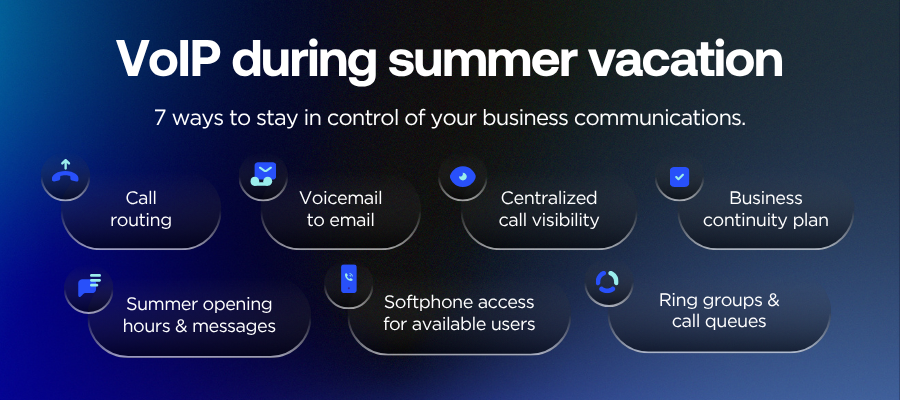
Below are seven practical ways businesses can use VoIP telephony to maintain control of their communications during the summer holiday period.
1. Adjust Call Routing Around Annual Leave Schedules
The first step is to ensure that incoming call flows are still not connected to employees who are away.
Through a cloud phone system, you can define:
-
which users are available each day,
-
which department will provide cover,
-
the order in which users or departments will receive a call,
-
where a call will be forwarded if there is no answer,
-
what should happen outside the business’s summer opening hours.
For example, a call to the sales department can initially ring the sales representatives who are currently available. If nobody answers, it can be forwarded to the employee covering the shift, another office or, as a final step, voicemail.
This means the business does not need to publish a different phone number or expect customers to know which employee is currently on leave.
Practical tip: Create a temporary summer call-routing rule before the main annual leave period begins. Define at least one alternative route for every critical department.
The modulus vPBX operates entirely over the internet and supports remote use and management without requiring a physical server on the business premises.
2. Set Up Summer Opening Hours and Informational Messages
When a company changes its opening hours, the way it handles incoming calls should change accordingly.
An updated recorded message can clearly explain:
-
the company’s summer opening hours,
-
the dates on which the business will be closed,
-
the expected response time,
-
the available support options,
-
how customers should contact the company in an emergency.
The message does not need to be generic or impersonal. It can guide the caller towards a specific action:
“For technical support, press 1. For billing enquiries, press 2. To leave a message and receive a call back on the next business day, press 3.”
This means that even when fewer departments are operating, customers know that their call has reached the right place and understand what will happen next.
An Interactive Voice Response system, or IVR, helps the business inform callers immediately, reduce incorrect transfers and direct each enquiry to the available team.
3. Give Available Employees Secure Softphone Access
VoIP telephony allows employees who are scheduled to work to answer business calls from different locations without using their personal phone number as the business contact number.
Through a softphone application on a computer, smartphone or tablet, authorised employees can:
-
make and receive business calls,
-
display the official business phone number,
-
use their business extension,
-
transfer calls to other members of the team,
-
access the features of the company’s phone system.
This is particularly useful when an employee is temporarily working from home, another branch or a different location during the summer period.
It does not mean that employees should answer business calls while they are on annual leave. Instead, it allows the company to provide access only to the employees who have been assigned to cover calls, without interrupting the personal time of colleagues who are away.
The remote work communication solutions offered by modulus allow available users to manage business calls across different devices and locations. The modulus softphone applications are available for Windows and mobile devices and allow users to make calls through their VoIP number wherever they are working.
4. Use Ring Groups and Call Queues
When a team is operating with fewer employees, simply forwarding every incoming call to one person can create a different problem: an excessive workload for the employee who remains available.
Ring groups and call queues enable a more balanced distribution of incoming calls.
Depending on the needs of the business, calls can:
-
ring several available users simultaneously,
-
be distributed to users in a predefined sequence,
-
be forwarded to the first available employee,
-
move to a secondary team when the waiting time exceeds a set limit,
-
be directed to voicemail when no representative is available.
For example, the customer service department may operate with two employees instead of five. If both lines are busy, the incoming call can remain in a queue with an informational message before following an alternative route.
This makes reduced staffing a predictable operational condition rather than a reason for losing control of business calls.
5. Activate Voicemail to Email and Organise Callbacks
It may not always be possible to answer every call at the moment it is received. What matters is that the business knows the call took place and has an organised callback process.
With Voicemail to Email, a voice message can be sent automatically to a shared business inbox together with information such as:
-
the caller’s phone number,
-
the time of the call,
-
the duration of the message,
-
the audio recording itself.
The feature can also be activated according to the company’s schedule through a cloud vPBX.
To make Voicemail to Email genuinely useful, it should be supported by a clear workflow:
-
Set up a shared mailbox for voicemail notifications.
-
Assign a specific person to check it each day.
-
Define a target response time, such as the same business day or the next business day.
-
Record which requests have already been handled.
-
Escalate urgent enquiries to the appropriate team.
Voicemail should not become a place where unanswered enquiries accumulate. It should be part of a structured callback process.
6. Maintain a Centralized View of Call Activity
During annual leave periods, it can be easy to lose visibility when calls are being answered by different employees or from different locations.
The centralized management of a cloud phone system helps the business monitor:
-
which calls were answered,
-
which calls were missing,
-
which users were available,
-
how incoming calls were routed,
-
whether the cover rules need to be adjusted.
This visibility is particularly useful when a manager or administrator is not physically present in the office. Necessary changes can be made without requiring direct access to on-site telephone infrastructure.
Call data can also show whether the temporary summer plan is working effectively or whether one department is receiving more calls than the available team can handle.
Important: Remote management does not mean continuously monitoring employees. Its purpose is to identify operational gaps, improve call handling and protect the quality of customer service.
The modulus vPBX supports centralised cloud management, call routing and remote access without requiring employees to be physically present in the same location.
7. Create a Business Communication Continuity Plan Before Annual Leave Begins
The best time to organise summer call management is not after the first important call has already been missed.
Before the holiday period begins, the business can create a short communication continuity plan that includes:
-
employee attendance and annual leave schedules,
-
available users in each department,
-
alternative cover teams,
-
summer opening hours,
-
welcome and out-of-hours messages,
-
call forwarding and overflow rules,
-
the person responsible for checking voicemail,
-
the procedure for managing urgent enquiries,
-
the contact details for technical support.
Before implementing the plan, test it using real calls.
Check what happens when a user does not answer, when all available lines are busy and when a call is made outside business hours.
Special attention should also be given to the security of remote access.
ENISA recommends secure Wi-Fi connections, up-to-date security software, secure connections to the work environment and encryption tools. It also advises employers to provide authentication and secure-session capabilities, establish clear emergency procedures and ensure employees know who to contact if a problem occurs.
Summer Business Telephony Checklist
Before the first member of the team begins their annual leave, check that:
-
Calls are not being forwarded to employees who will be away.
-
There is at least one alternative route for every essential department.
-
Summer opening hours have been configured correctly.
-
Recorded messages contain accurate and current information.
-
Available employees have tested their softphone applications.
-
A specific person is responsible for voicemail and missing calls.
-
Overflow and out-of-hours scenarios have been tested.
-
Devices and applications are fully updated.
-
Everyone knows what to do if a technical problem occurs.
Your Business Communications Do Not Have to Go on Vacation
Summer annual leave is a completely normal part of business operations. It does not, however, need to result in missed calls, improvised call forwarding or employees being contacted while they are off work.
With the right configuration, VoIP telephony allows a business to:
-
organize call cover around actual availability,
-
keep its official business number active,
-
serve customers from different locations,
-
provide callers with accurate information,
-
record enquiries that require a callback,
-
adapt its operations without changing its physical telephone infrastructure.
Most importantly, the business remains organized without requiring the entire team to remain constantly available.
With business VoIP telephony and the modulus cloud vPBX, you can create a flexible call-management plan that follows the needs of your business, not only during the summer, but throughout the year.