Why Is Summer a Stress Test for Business Communications?
Summer tests whether a business can continue serving customers and partners when the composition, location and availability of its team temporarily change.
In a traditional telephony model, business communication is often connected to:
-
a physical desk phone,
-
a specific office,
-
an employee who knows how calls should be handled,
-
basic call forwarding to a personal mobile number,
-
a phone system that requires on-site access whenever changes are needed.
As long as everyone is working from the office, these limitations may not be immediately visible. When annual leave begins or the physical presence of the team is reduced, however, dependence on these individual points becomes an operational risk.
What Strategic Need Does VoIP Telephony Address?
VoIP telephony separates business communications from a particular location or device and turns telephony into a flexible, centrally managed business function.
This means that the company’s phone numbers, call-routing rules, extensions, schedules and customer service functions do not need to change every time the physical presence of the team changes.
The value of VoIP is therefore not limited to forwarding a call from one number to another. It lies in creating a communication system that can adapt without losing consistency, professional identity or centralized control.
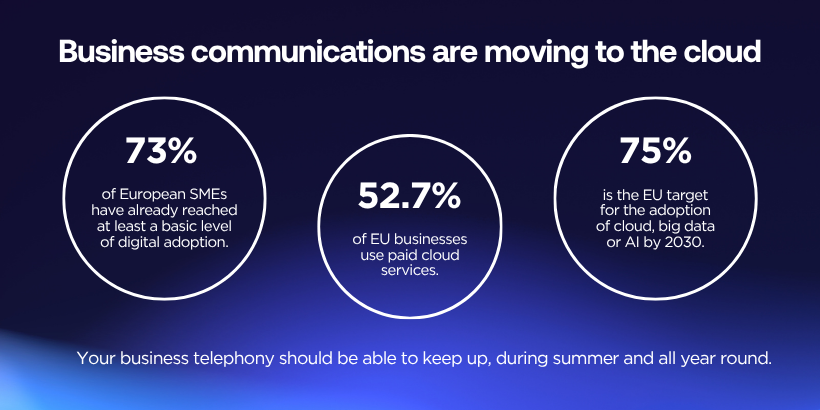
The broader direction of Europe’s digital transformation reflects this approach. The European Union has set two major targets for 2030: more than 90% of SMEs should reach at least a basic level of digital intensity, while 75% of EU companies should use cloud computing, big data analytics or artificial intelligence. In 2024, 73% of European SMEs had reached at least a basic level of digital intensity.
The Strategic Value of VoIP Telephony During Annual Leave
Communication Follows Business, Not the Workplace
In a cloud telephony environment, the company’s business number is not tied to a particular desk phone.
Authorised users can manage calls from the office, their home, another branch or any approved workplace while maintaining the same professional telephone identity.
The company does not need to publish different phone numbers or depend on employees’ personal mobile numbers to manage temporary operational changes.
Business VoIP telephony supports remote management, simultaneous calls and the use of different compatible devices, without making business communication dependent on the physical office.
The Customer Experience Remains Consistent
Customers do not need to know which employee is on annual leave, which department is operating with fewer people or where the representative answering their call is located.
What matters to the customer is being able to:
-
call the business number they already know,
-
receive clear and accurate information,
-
reach the appropriate department,
-
understand what will happen if nobody is immediately available,
-
avoid repeating the same request to several different people.
A cloud-based vPBX phone system allows the business to maintain consistent call flows, IVR menus, user groups, schedules and customer service functions, regardless of where individual team members are working.
Technology remains in the background. What the customer experiences is organised, available and professional business.
Business Reduces Its Dependence on Specific Individuals
In many small and medium-sized businesses, responsibility for managing telephony is informally concentrated around one or two people.
One employee knows who should answer each type of call, where it should be transferred and which requests should be treated as urgent. When that employee is away, this knowledge is not always automatically transferred to the rest of the team.
Cloud telephony allows these rules to be built directly into the system.
Call management can be organised according to:
Customer service no longer depends exclusively on one person’s availability or memory.
Reducing this dependency is not only useful during summer annual leave. It also protects business operations in cases of illness, role changes, increased workloads or unexpected absences.
Management Gains a Centralised View of Business Communications
Flexibility has limited value without visibility.
When calls are routed to different personal mobile phones or handled through fragmented forwarding arrangements, it becomes difficult for the business to know:
-
how many calls were received or made,
-
how many calls were answered,
-
which enquiries remain unresolved,
-
which department received the highest call volume,
-
whether the temporary cover model is working effectively.
Centralised management transforms telephony from a series of isolated calls into a business function that can be monitored and improved.
Through a unified environment such as the mymodulus management platform, users can access incoming and outgoing call history, manage call-forwarding settings and activate additional services such as voicemail and missed-call notifications.
This information allows management to make decisions based on actual communication activity rather than estimates or assumptions.
Business Gains Flexibility Without Permanent Investment in On-Site Infrastructure
Seasonal communication requirements are not always stable.
During the summer, a business may temporarily require:
-
additional users,
-
cover from another department,
-
remote access for selected employees,
-
different operating hours for a few weeks,
-
additional inbound call-management features.
In a traditional telephony model, these changes may require new hardware, on-site technical work or a permanent increase in local infrastructure.
The modulus cloud vPBX operates entirely in the cloud without requiring a physical server on the company’s premises. It can be accessed through computers and mobile devices, making it easier to adapt telephony to the changing requirements of the team.
Its strategic value lies in this adaptability. A company should not have to design its business telephony only around the most typical working day of the year.
Remote Access Does Not Mean Working During Annual Leave
The ability to connect from anywhere can easily be misunderstood as an expectation that employees should always remain available. A properly organized VoIP solution can help achieve the opposite.
When calls are routed according to the team’s actual schedule, employees who are on annual leave can be removed from active call flows. Communication is transferred to the employees officially responsible for providing cover, without last-minute personal arrangements.
VoIP remote work solutions allow available employees to make and receive business calls from different devices and locations while retaining the company’s business number and phone-system functionality.
The objective is not for every employee to remain connected during their holidays. The objective is for the business to remain connected with the people who are scheduled to work.
Telephony Becomes Part of Business Continuity
Business continuity is not limited to major crises or the complete failure of a system.
It refers to a company’s ability to continue performing critical operations when normal conditions change.
A business continuity and disaster recovery plan should include elements such as:
-
clearly defined roles and responsibilities,
-
key points of contact,
-
internal and external communication channels,
-
the order in which operations should be restored,
-
the resources required for recovery,
-
backups and redundancy,
-
procedures for returning from temporary measures to normal operations.
Business continuity and disaster recovery plans should be tested, reviewed and updated at scheduled intervals, taking previous incidents and test results into account.
Telephony is an essential part of this approach because, during a disruption, a business must continue communicating with:
-
customers,
-
employees,
-
partners,
-
suppliers,
-
technical support,
-
external organisations.
A telephone infrastructure that depends on a single location or person creates a potential point of failure. Cloud infrastructure with alternative routing paths and centralized management strengthens the resilience of the business.
Why Is Basic Call Forwarding Not the Same as Business Continuity?
Call forwarding can be useful as an individual feature. On its own, however, it does not represent a complete business continuity strategy.
| Simple Call Forwarding |
VoIP and Cloud Phone System |
| Forwards the call to a single number |
Routes calls based on working hours, team and availability |
| Often depends on one person |
Distributes responsibility among available users |
| Provides limited visibility |
Provides centralized call history and activity data |
| Does not necessarily guide the caller |
Supports IVR, recorded messages and call queues |
| May redirect calls to a personal mobile phone |
Maintains a consistent business phone identity |
| Provides a temporary solution to a problem |
Creates a repeatable and manageable process |
| Does not scale easily |
Adapts to more users, departments and locations |
The difference is not simply the number of available features. It is whether the business maintains control of its communications.
Which Businesses Gain the Most Strategic Value from VoIP?
The value of cloud telephony becomes particularly clear for businesses that:
-
receive a high volume of inbound calls,
-
depend on telephone sales or customer support,
-
operate more than one office or branch,
-
work in shifts,
-
experience seasonal staffing changes,
-
employ remote or hybrid workers,
-
serve customers outside standard business hours,
-
depend on specific individuals to manage incoming calls,
-
require a unified view of communication across different departments.
For these organisations, a missed call is not simply a technical event. It may represent a customer request, a sales opportunity or critical information that did not reach the appropriate person in time.
How Do modulus Solutions Support Communication Continuity?
The right solution depends on the size, structure and operational model of each business.
modulus business VoIP telephony provides flexible number management, simultaneous calls, number portability and remote service administration.
The modulus cloud vPBX phone system adds centralised management of users, departments, schedules and call flows without requiring an on-site server.
VoIP solutions for remote work allow authorised team members to use the company number and business phone-system functions from different locations.
For organisations with more advanced requirements, business continuity solutions from modulus combine telecommunications infrastructure, customised recovery plans, off-site storage and 24/7 technical support.
At the same time, VoIP integration with CRM and customer communication platforms can help teams manage calls, customer information and communication history within a more unified working environment.
From Summer Call Cover to Long-Term Business Resilience
The annual leave period provides a valuable opportunity for a business to examine how resilient its telephony infrastructure really is.
The most important question is not only: “Where will we forward our calls during August?”
It is: “Can our communications continue operating when the people, locations and conditions change?”
A modern phone system should not require a complete redesign every time an employee is away. It should adapt to change, maintain consistent customer experience and provide the visibility a business needs to remain in control.
With VoIP telephony and cloud communication solutions from modulus, business communications can remain organized throughout the summer holiday period while continuing to support the company during any period of change or increased demand.