7 Biggest Cybersecurity Risks for Businesses in 2026
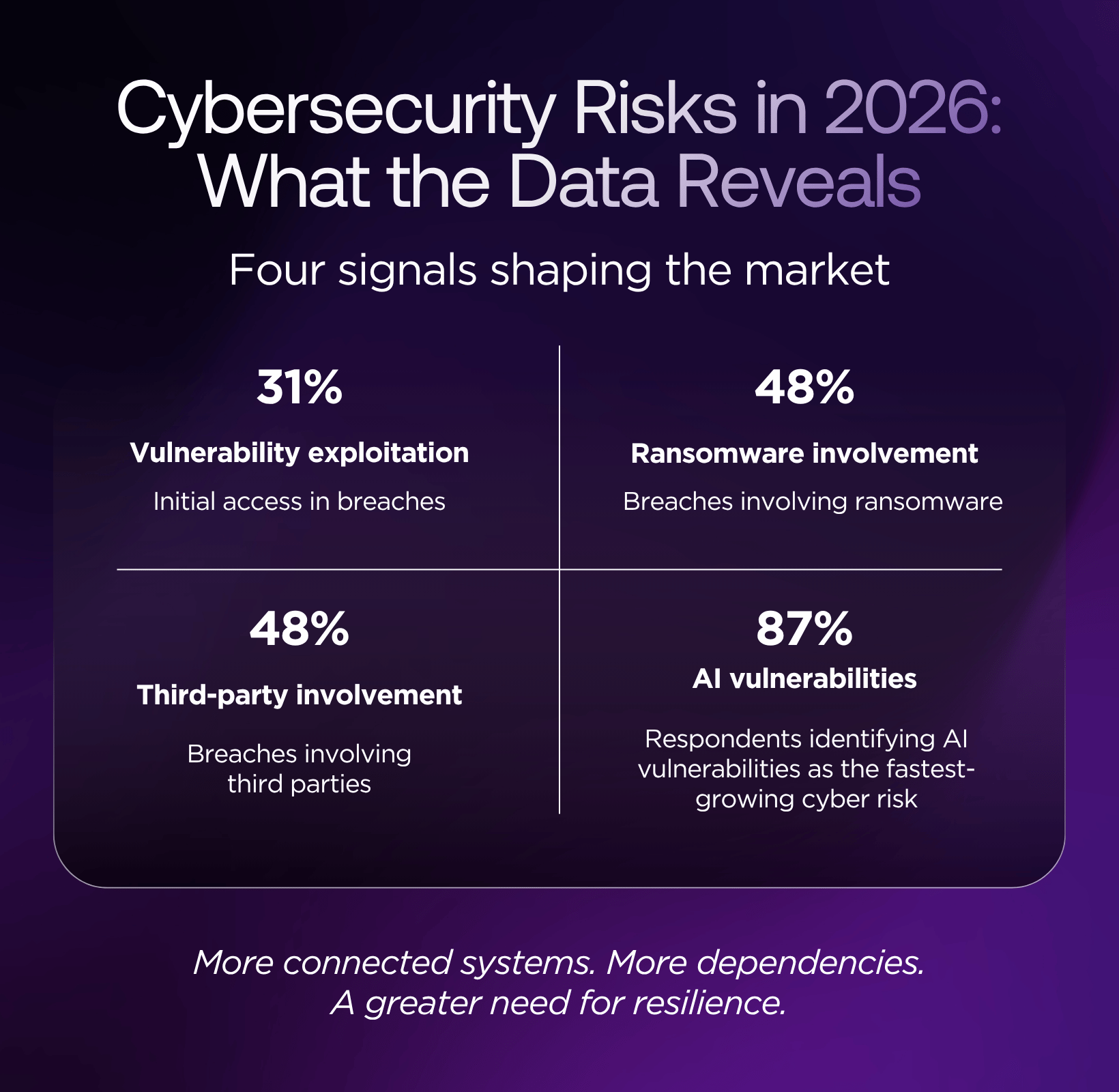
- Software vulnerabilities: According to the Verizon DBIR 2026, vulnerability exploitation is now the most common initial breach vector, accounting for 31%.
- Ransomware: It is involved in 48% of the breaches analyzed by Verizon, reinforcing its continued significance as a business risk.
- Phishing and social engineering: These remain important initial access methods, while AI can make deceptive communications more convincing and easier to scale.
- Third-party risk: Breaches involving third parties highlight the growing exposure created by businesses' dependence on external systems and providers.
- AI security: 87% of respondents in the World Economic Forum's Global Cybersecurity Outlook 2026 identified AI-related vulnerabilities as the fastest-growing cyber risk during 2025.
- Communications and integrations: Security must be considered across the entire chain of interconnected systems, from telephony and APIs to CRM platforms and AI Agents.
- Business resilience: Resilience depends not only on prevention, but also on the ability to detect, contain, and recover from security incidents.
Sources: Verizon 2026 Data Breach Investigations Report; World Economic Forum, Global Cybersecurity Outlook 2026.
What Has Changed in Business Cybersecurity in 2026?
The most significant change is not necessarily the emergence of entirely new types of cyberattacks. It is that familiar threats are evolving within a much more interconnected technology environment.
Businesses now rely on more cloud applications, APIs, digital services, collaboration tools, and automation. At the same time, they are integrating AI into processes that, until recently, required exclusively human involvement.
These technologies create substantial opportunities for productivity and growth. However, they also introduce additional potential entry points for attackers.
In its Global Cybersecurity Outlook 2026, the World Economic Forum identifies three major forces shaping the cybersecurity landscape: rapid AI development, geopolitical developments, and widening disparities in cybersecurity capabilities between organizations.
The implication for businesses is highly practical.
It is no longer enough to assess whether each individual application or service is secure. Organizations also need to understand how these services connect, what data they exchange, and what happens when one component of the wider ecosystem is compromised or becomes unavailable.
The security of an interconnected environment is not simply the sum of the security of its individual applications.
1. Why Are Software Vulnerabilities Among the Biggest Cybersecurity Risks?
Software vulnerabilities represent one of the most significant cybersecurity risks in 2026, as attackers exploit weaknesses in internet-facing applications and systems to gain unauthorized access, sometimes without needing to steal credentials.
According to the Verizon DBIR 2026, 31% of breaches begin with the exploitation of software vulnerabilities.
This represents a notable shift: in Verizon's research, vulnerability exploitation has overtaken the use of stolen credentials as an initial breach vector.
IBM's X-Force Threat Intelligence Index 2026 reinforces this picture. Based on incidents investigated by X-Force, the exploitation of internet-facing applications emerged as the most common initial access method, increasing by 44% compared with the previous year.
What Does This Mean for an Interconnected Business?
A vulnerability in one application does not necessarily remain isolated within that system.
Consider a business using a cloud CRM connected through APIs to its telephony system, Help Desk, and customer notification platform.
If a vulnerable application allows unauthorized access, the extent of the incident will depend on the permissions, integrations, and security controls in place.
An attacker may potentially gain access not only to one application, but also to data or functionality within other connected systems.
This highlights the importance of attack surface management: the systematic identification, monitoring, and protection of potential entry points that attackers could exploit.
For businesses, practical priorities include applying security patches regularly, maintaining an inventory of internet-facing applications, reviewing access permissions, and limiting unnecessary integrations.
The objective is not simply to fix a vulnerability. It is to reduce the likelihood that an incident can spread beyond the system initially affected.
2. Ransomware: Why Does It Remain Such a Significant Threat?
Ransomware remains one of the most serious cybersecurity threats facing businesses because attacks can involve a combination of file encryption, data theft, extortion, and disruption of critical operations.
According to the Verizon DBIR 2026, ransomware was involved in 48% of the breaches analyzed, compared with 44% in the previous year.
At the same time, 69% of ransomware victims in the relevant dataset did not pay the ransom.
These findings reveal an interesting contrast: even as more victims refuse to pay, ransomware remains a widespread threat.
The ENISA Threat Landscape 2026 also identifies ransomware as the type of incident with the greatest short-term impact across the European threat landscape.
The Real Cost Goes Beyond Data Loss
Consider a different scenario.
A business experiences a ransomware attack and temporarily loses access to its CRM and ERP systems.
Even if its telephony service continues to operate normally, customer service agents may no longer have access to order information, customer histories, or support tickets.
Calls can still be made and received, but the business struggles to provide effective service.
This demonstrates that the availability of an individual service does not necessarily guarantee business continuity.
A Disaster Recovery Plan focused exclusively on restoring files may not be sufficient.
It should also answer questions such as: Which business functions must be restored first? How will teams communicate if internal tools are unavailable? How will customers be informed? And which alternative communication channels can be used until systems are fully restored?
Resilience is not determined solely by whether a business has backups. It also depends on whether recovery procedures have been tested and whether the organization knows how to continue operating during an incident.
3. Phishing and Social Engineering: Why Does Human Factor Still Matter?
Phishing remains a significant cybersecurity risk because it exploits trust, urgency, and everyday business processes to obtain credentials or persuade employees to perform unauthorized actions.
The ENISA Threat Landscape 2025, which analyzed nearly 4,900 selected incidents between July 2024 and June 2025, identified phishing as the leading initial intrusion method, accounting for 60%, followed by vulnerability exploitation at 21.3%.
This finding does not contradict Verizon's 31% figure for vulnerability exploitation in 2026. The two reports examine different datasets, periods, and methodologies.
The broader implication is that both technical weaknesses and human deception remain important opportunities for attackers to gain access.
Phishing Is No Longer Limited to Email
A malicious email filled with obvious spelling mistakes is no longer the only recognizable example of phishing.
Today, an attempted scam may appear as a message from a business partner, a notification from a cloud application, a request to change payment details, or a phone call supposedly coming from someone the recipient knows.
AI can make these communications more polished, personalized, and convincing.
This changes the nature of social engineering risks, particularly in business processes where employees are expected to respond quickly.
For example, an employee might receive a phone call from someone claiming to represent a technical partner, urgently requesting a configuration change or the disclosure of a password.
The critical question is not whether the caller sounds convincing, but whether the business has a process for verifying both the person's identity and the legitimacy of the request.
Why Is MFA Essential but Not Enough?
Multi-Factor Authentication (MFA) adds an important layer of protection by requiring more than a password to access an account.
However, it does not eliminate every form of social engineering.
Some attacks attempt to trick users into approving authentication requests, sharing verification codes, or granting access to malicious applications.
Protection therefore requires a combination of strong authentication, carefully managed permissions, and clear verification procedures.
The right question is not only, "Do we use MFA?" but also, "What critical actions can a user perform after successfully signing in?"
4. Third-Party Risk: Could the Biggest Threat Come from Outside the Business?
Third-party cybersecurity risks are increasing as businesses become more dependent on cloud platforms, external partners, software providers, and interconnected systems.
The Verizon DBIR 2026 reports third-party involvement in 48% of breaches within its dataset, representing a 60% increase compared with the previous year.
Importantly, this does not mean that every breach was directly caused by the third-party provider.
Why does this matter? Because outsourcing a service does not automatically mean outsourcing business responsibility.
A company may not develop the software it uses, but it still depends on that software's availability, security, and reliable operation.
Integrations Improve Productivity, but They Also Require Control
Consider business using:
- A CRM to manage customer relationships.
- A Help Desk to handle support requests.
- A cloud telephony platform.
- A messaging application for automated notifications.
- An AI platform to automate responses.
When these systems are connected, they create a more efficient communication environment.
However, every integration introduces additional security considerations.
Which system can access which data? Which APIs can trigger actions? How are authentication tokens protected? What happens if a partner or connected application is compromised?
The principle of least privilege, which limits users and applications to the minimum permissions required, becomes particularly important.
The same applies to regular access reviews, secure management of API credentials, monitoring for unusual activity, and the ability to revoke access immediately when necessary.
VoIP integrations with CRM and customer communication platforms provide a clear example of how communications are becoming part of a wider business technology ecosystem.
This evolution creates new capabilities but also highlights the need for architecture with clearly defined access boundaries and security controls.
Good integration should not allow information to flow between systems. It should also make clear who can access that information, under what conditions, and with which permissions.
5. How Is AI Changing Cybersecurity Risks?
Artificial Intelligence is reshaping the cybersecurity landscape in two ways: it can strengthen attackers' capabilities, while also introduce new risks when integrated into business systems without adequate safeguards.
According to the World Economic Forum's Global Cybersecurity Outlook 2026:
- 94% of respondents consider AI the most significant driver of change in cybersecurity over the coming year.
- 87% identified AI-related vulnerabilities as the fastest-growing cyber risk during 2025.
The same report found that the share of organizations with processes for assessing the security of AI tools increased from 37% in 2025 to 64% in 2026.
This suggests that the market is beginning to shift from asking, "How can we use AI?" to asking, "How can we integrate AI securely?"
From AI as a Tool to AI as Part of Business Infrastructure
An AI tool used to draft a document has a different risk profile from an AI Agent connected to a CRM, retrieving customer information, and performing actions in real time.
In the second scenario, security is not only about the data processed by the model.
It also involves:
- The systems the AI Agent can access.
- The permissions it has been granted.
- The information it can retrieve or disclose.
- The actions it is authorized to perform.
- How those actions are monitored and logged.
- Whether human intervention is possible when required.
AI Agents introduce an important new consideration: depending on their implementation, they do not simply process information. They can also act on it.
What Is Prompt Injection, and Why Should Businesses Care?
Prompt injection is a type of attack in which malicious instructions are embedded in content processed by an AI system, with the intention of influencing its behavior.
For example, an AI Agent may analyze customer emails or retrieve content from an external knowledge base.
If the system does not properly distinguish untrusted information from authorized instructions, malicious content may attempt to trigger unintended actions.
The risk becomes greater when the AI Agent has access to business tools.
In such environments, protection cannot rely solely on better-written prompts.
It requires limited permissions, controls over the tools an Agent can use, verification of sensitive actions, and a clear separation between data and instructions.
Why Does Voice AI Introduce Another Layer of Security Considerations?
AI Voice Agents bring Artificial Intelligence into real-time business communications, enabling automated customer interactions and integration with CRM platforms and other business systems. However, their secure operation requires appropriate access controls, identity verification, and clearly defined authorization rules for executing actions.
Imagine a customer calling to change the delivery address of an order.
The AI Agent may understand the request and have access to the relevant information. However, understanding a request is not the same as verifying the caller's identity.
Making such a change requires separate authorization rules.
This becomes even more important for higher-risk actions, such as modifying personal information, accessing financial data, or changing services.
For businesses integrating AI Voice and Conversational platforms with their telephony infrastructure, security should be assessed across the entire workflow: from the telephone connection and AI platform to the APIs and business systems the Agent can access.
An AI Agent's ability to understand a request should never be confused with its authorization to execute it.
6. How Secure Are Business Communications?
Business communication security involves much more than protecting the content of a phone call or message. It includes verifying the identity of callers and senders, protecting telephony infrastructure, managing access, and maintaining service availability.
Communication is a critical part of everyday business operations.
Customer service, internal approvals, partner coordination, and the exchange of business information all rely on channels such as phone, email, and messaging.
When one of these channels is compromised or used for deception, the consequences can extend far beyond the communication itself.
Caller ID Spoofing: Can We Trust the Number Displayed on Our Screen?
Caller ID Spoofing (CLI Spoofing) is the practice of falsifying the caller identification number so that a phone call appears to originate from a different number.
Combined with social engineering techniques, it can be used to deceive businesses and consumers.
For example, an employee may receive a call displaying a number that appears to belong to a familiar business partner. However, the number displayed alone does not prove the caller's identity.
Verification procedures are therefore particularly important when telephone interactions involve payments, account changes, access credentials, or confidential information.
Addressing these threats is a shared concern for telecommunications providers and the businesses using their services.
In Greece, measures to combat CLI Spoofing have also been introduced through regulatory interventions by the Hellenic Telecommunications and Post Commission (EETT).
Although technical measures can reduce certain forms of caller ID manipulation, they do not eliminate the need for identity verification in critical business processes.
VoIP Security: What Needs to Be Protected in a Modern Telephony Environment?
VoIP security is an essential component of protecting business communications. In a modern business telephony environment, security extends beyond protecting phone calls to include SIP credentials, access to the Private Branch Exchange (PBX), connected endpoints, and integrations with other business applications.
Where supported and properly configured, technologies such as TLS and SRTP can help protect signaling and voice media streams, respectively.
Monitoring unusual calling activity can also help identify incidents such as unauthorized outbound calls or sudden changes in service usage.
A comprehensive security approach should therefore include secure credential management, restricted permissions, regular updates to telephony systems, secure interconnection settings, and monitoring mechanisms.
When telephony connects with CRM systems, collaboration platforms, or AI services, the security of systems beyond the telephone network itself also becomes increasingly important.
7. Why Is Business Resilience Becoming as Important as Prevention?
Business resilience is an organization's ability to maintain critical operations, limit the impact of an incident, and restore services effectively.
Traditionally, cybersecurity has been strongly associated with preventing unauthorized access.
However, no security system can guarantee that an incident will never occur.
This is shifting some of the focus from prevention alone toward preparedness, incident management, and recovery.
The ENISA Threat Landscape 2026 highlights the growing importance of digital dependencies, while the World Economic Forum points out how disruptions across interconnected infrastructure can create consequences beyond the initially affected system.
What Happens When a Business Loses Access to Its Main Communication Channels?
Imagine a business experiencing a serious cybersecurity incident that affects its corporate email and customer service platform.
- How will it inform customers?
- How will employees communicate with one another?
- Who will coordinate the incident response, and through which channel?
The answers cannot depend exclusively on the same applications that may have been affected.
A comprehensive business continuity plan should provide alternative communication methods, clearly assigned responsibilities, communication procedures, and regular testing.
Simply having more communication channels does not automatically guarantee resilience.
If those channels depend on the same infrastructure or identity management system, they may be affected simultaneously.
Why Do Redundancy and Failover Matter for Business Continuity?
Redundant infrastructure and failover mechanisms can reduce the risk of service disruption when an individual infrastructure component fails.
For example, in a high-availability telephony environment, alternative routing paths and appropriate recovery mechanisms can help maintain communication during certain failure scenarios.
However, redundancy alone does not provide protection against every type of cyberattack.
If a compromise affects shared credentials, administrative functions, or common dependencies, backup infrastructure may also be affected.
Resilience therefore requires a combination of technical availability, separation of critical infrastructure, secure access management, and clearly defined incident response procedures.
True resilience is not simply about having a backup system. It is about knowing whether that system will work when it is needed.
How Should Businesses Rethink Their Cybersecurity Strategy in 2026?
A cybersecurity strategy in 2026 should be based on a comprehensive understanding of business systems and their dependencies, rather than a collection of isolated technology solutions.
In its X-Force Threat Intelligence Index 2026, IBM highlights how many serious security incidents continue to be associated with weaknesses in fundamental security controls, despite the growing availability of advanced technologies.
This points to an important conclusion: adopting sophisticated security tools does not replace the need for well-designed foundational processes.
For businesses using cloud infrastructure, APIs, telephony, and AI, cybersecurity priorities can be organized around five key areas.
1. Understand Your Technology Dependencies
Document not only the applications your business uses, but also the relationships between them.
Which platforms connect to your CRM? Which tools can access customer data? Which business operations depend on an external provider?
Mapping these dependencies can reveal risks that may be overlooked when each application is assessed independently.
2. Protect Identities and Access Permissions
Implement MFA wherever available and prioritize phishing-resistant authentication methods for high-risk accounts.
Limit user and application permissions to the minimum required.
Regularly review access granted to employees, partners, and third-party applications, particularly when responsibilities change or business relationships end.
3. Treat APIs and Integrations as Part of Your Attack Surface
Integrations between applications require the same level of attention as the applications themselves.
Secure credential storage, limited API permissions, access controls, activity logging, and token revocation capabilities are essential considerations.
For example, when VoIP telephony integrates with communication and collaboration platforms, the entire solution architecture must be considered, not only the functionality of the integration.
4. Establish Boundaries for Automation and AI Agents
Automation should not mean unrestricted access.
Define which actions an AI system can complete independently and which require additional verification or human approval.
Also consider how actions are logged, how access to data is restricted, and how unusual or unexpected behavior is handled.
5. Test Your Business Continuity Capabilities
Do not stop creating a business continuity document.
Conduct exercises that simulate the unavailability of a critical system or communication channel.
Who makes the decisions? Who informs customers? Which function must be restored first? Is there an alternative way to provide support?
The answers to these questions are often more valuable than adding another security tool.
How Are Cybersecurity, AI, and Business Communications Becoming Connected?
Cybersecurity, AI, and business communications are increasingly converging because they rely on shared infrastructure, interconnected applications, and automated information flows.
A modern customer service environment may include telephony, CRM, messaging, AI Voice Agents, and a Help Desk.
For the customer, these technologies form a single service experience.
For the business, however, they represent a collection of different systems that must work together securely and reliably. This creates a new challenge.
Technology can no longer be evaluated solely by what each system can do. Businesses must also consider how systems connect, what data they exchange, which permissions they require, and how they behave when something goes wrong.
From the perspective of a technology and telecommunications provider, this is one of the most significant shifts taking place in the market.
Business telephony no longer necessarily operates as a standalone system. Through cloud infrastructure, SIP, APIs, and integrations, it can connect with tools supporting sales, customer service, and automation.
This transforms telephony infrastructure into part of a broader business technology environment.
Similarly, AI integration creates new communication capabilities, but also requires clearer rules governing data access, identity verification, and the execution of actions.
Developing more intelligent communication systems must therefore be accompanied by equally mature approaches to security and resilience.
The future of business communications will not be determined solely by how connected or automated systems become, but also by how reliably they can operate together.
Cybersecurity in 2026: From System Protection to Business Resilience
Cybersecurity risks in 2026 demonstrate why protecting a business can no longer be treated as an exclusively technical responsibility.
Phishing, ransomware, and software vulnerabilities remain serious threats. At the same time, the expansion of cloud services, APIs, and AI applications is creating new technological dependencies. The objective, therefore, is not simply to adopt more security tools. It is to build an environment where access is controlled, systems interact according to clear rules, and critical business operations can continue even when an incident occurs.
Cybersecurity Awareness Month provides a valuable reminder of this need. However, cybersecurity cannot be limited to an annual awareness campaign. It must become part of everyday technological and business decisions.
Because the more connected a business becomes, the more important it is to understand not only how its systems work, but also how they are protected when something goes wrong.