Digital and Green Transformation | Key Takeaways
-
Digital does not automatically mean green. The environmental value of a technology investment must be demonstrated through measurable results.
-
Greece is developing its digital infrastructure, but business adoption remains a challenge. The gap is particularly evident in the use of advanced technologies by businesses.
-
AI is shifting the focus of transformation: from simply digitalizing processes to predicting outcomes, optimizing operations, and making better decisions.
-
Meaningful progress is measured in practice: lower consumption per unit of output, less waste, better customer service, and more efficient use of infrastructure.
1. How Is AI Changing Digital and Green Transformation?
Until recently, digital transformation was largely associated with cloud migration, document digitalization, ERP and CRM systems, and process automation.
AI introduces a new capability: systems can move beyond recording what is happening to predict what may happen next and recommending how businesses should respond.
In the energy sector, for example, data analytics can support more accurate demand forecasting and more efficient grid management.
In manufacturing, predictive maintenance models can identify potential equipment issues before they lead to breakdowns or unnecessary resource consumption.
A 2025 study by the European Commission highlights how AI, digital twins, and data analytics can contribute to the development of more efficient energy systems.
The change, therefore, is not only about the technology a business uses. It is also about the quality of the decisions that technology enables.
2. Where Does Greece Stand in the Twin Transition?
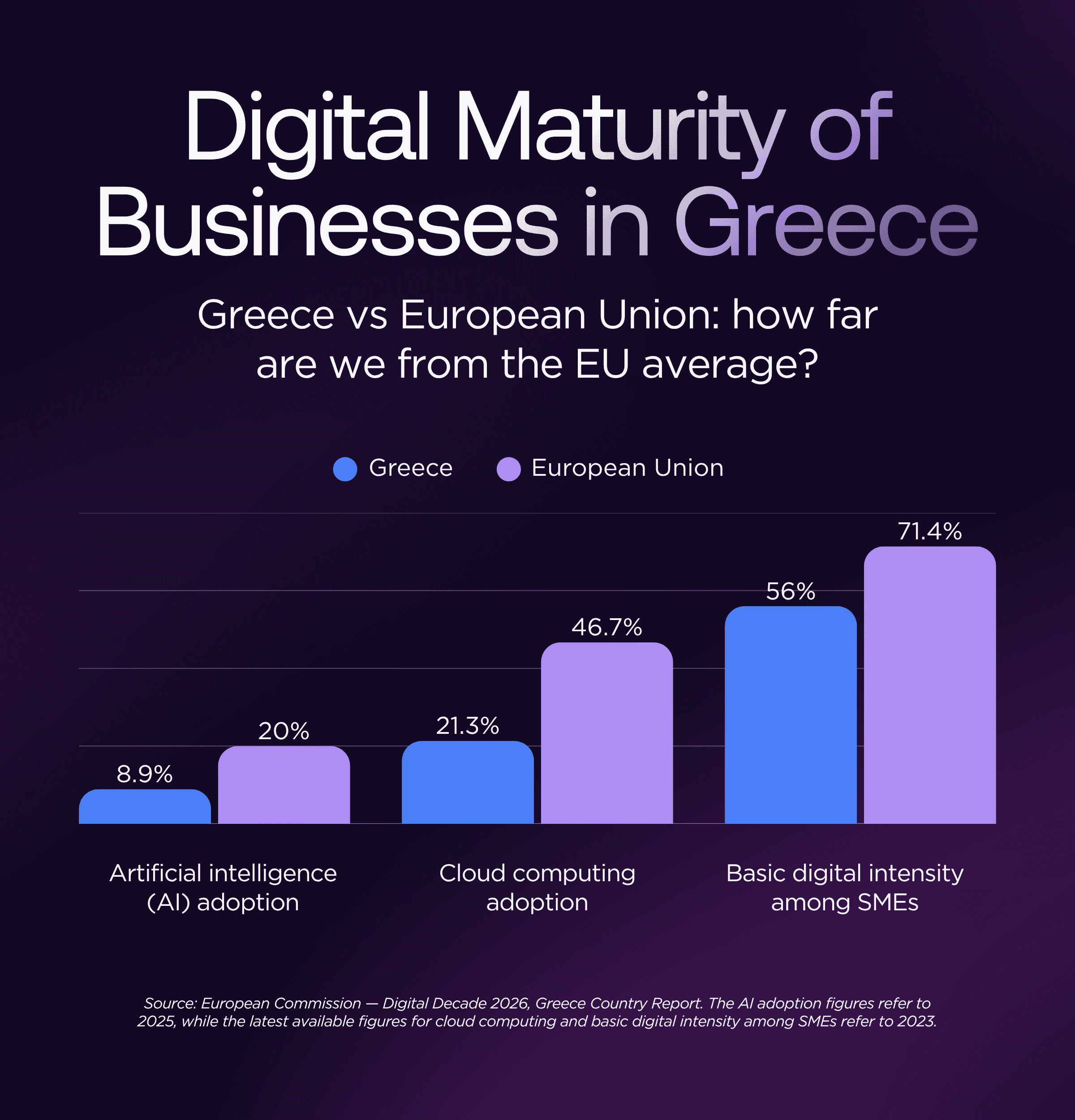
Digital transformation in Greece has progressed through investments in technological infrastructure and a growing innovation ecosystem. However, the adoption of advanced digital technologies, including Artificial Intelligence and cloud computing, remains a significant challenge for Greek businesses, particularly small and medium-sized enterprises (SMEs).
According to the European Commission's Digital Decade 2026 Country Report for Greece, AI adoption among Greek businesses remains below 10%, compared with an EU average of 20% in 2025.
The report also recognizes the development of important technological infrastructure, including Greece's AI Factory, while highlighting the continued need for stronger digital skills and faster adoption of advanced technologies, particularly among small and medium-sized enterprises (SMEs).
Greece has also committed significant resources to the Twin Transition. According to the European Commission, the country's Recovery and Resilience Plan allocates 38% of its resources to climate objectives and 21.4% to the digital transition.
However, an important distinction needs to be made:
Investment creates the conditions for transformation. Real change happens when businesses turn those investments into improvements in their everyday operations.
For a Greek SME, the challenge is not necessarily gaining access to the most advanced AI model. It is having reliable data, suitable infrastructure, and people with the skills to put that technology to effective use.
3. ΑI and the Risk of a Widening Business Divide
For the Greek economy, digital and green transformation presents a particular challenge: it must take place in a market dominated by microenterprises. According to the European Commission, these account for 94.5% of businesses in the non-financial business economy. This means that technological transformation cannot rely exclusively on large-scale investments or specialized in-house teams. It requires accessible solutions, connected systems, flexible service models, and meaningful investment in digital skills. Otherwise, AI risks widening an existing divide between businesses with the resources to innovate and those struggling to keep pace.
4. From Digital Investment to Real Productivity
There is, however, a deeper question about the competitiveness of the Greek economy: Will we use technology to create greater value, or simply to modernize the way we already operate? In sectors that play a significant role in Greece, such as tourism, agrifood, and services, the greatest opportunity may not lie in the most impressive AI application, but in solutions that reduce operating costs, minimize energy and water waste, and improve productivity. The next phase of transformation should therefore be measured less by the scale of investment and more by the value it delivers. Because an economy's progress is not defined by how much technology it acquires, but by how effectively it learns to use it.
5. How Can Greek Businesses Apply the Twin Transition in Practice?
Some of the most meaningful opportunities lie in everyday business processes, where a relatively small technological change can significantly improve efficiency.
Tourism: From Data Collection to Resource Management
A hotel can combine occupancy data, sensors, and AI-powered forecasts to adjust heating, cooling, and energy consumption according to actual demand.
The benefit is not simply that the hotel uses AI.
It is that the business can reduce unnecessary energy consumption without compromising the guest experience.
Agrifood: From Monitoring to Prediction
In agriculture, combining sensors, weather data, and AI can support more precise decisions about irrigation, fertilization, and crop management.
In a country where water resource management is becoming increasingly important, these applications create a direct connection between digital innovation and environmental efficiency.
Business Communications: From Isolated Systems to Intelligent Workflows
Transformation also affects less obvious business functions, including communication.
Digital transformation of business communications can be achieved by integrating VoIP telephony with CRM platforms, customer service solutions, and other business applications. These integrations enable automated information exchange, reduce repetitive manual tasks, and help businesses improve operational efficiency and productivity.
Integrating AI Voice Agents into business telephony enables companies to automate repetitive customer service requests, connect voice interactions with CRM platforms, and create intelligent workflows. This can reduce manual processes, improve response efficiency, and allow customer service teams to focus on more complex customer needs.
This can increase productivity and eliminate unnecessary steps. However, it does not automatically translate into a smaller environmental footprint.
And that distinction matters.
6. Could AI Growth Work Against the Green Transition?
Yes. Although Artificial Intelligence can support the green transition, developing and operating AI systems requires substantial computing power, data center infrastructure, and electricity. Therefore, the environmental sustainability of an AI solution must be evaluated by considering both the benefits it delivers and the resources required to operate it.
According to the International Energy Agency's (IEA) Energy and AI report, data centers consumed approximately 415 TWh of electricity globally in 2024. Under the agency's base-case scenario, that figure is projected to reach approximately 945 TWh by 2030.
That represents more than a doubling of electricity demand, with AI acting as a major driver of this growth.
This does not negate AI's potential to support sustainability. It does, however, highlight the need to consider the full energy and environmental costs of a technological solution.
For businesses, the right question is not only, "How much faster can we complete this process using AI?"
It is also: "How many resources are we saving compared with those required to operate the solution?"
Without this comparison, businesses risk confusing technological efficiency with environmental sustainability.
What Does Meaningful Transformation Look Like for a Greek Business?
Effective digital and green transformation does not necessarily begin with a major technology investment.
It begins with a real business problem.
A process that consumes more energy than necessary. Information trapped in disconnected systems. Repetitive tasks that could be automated.
The priorities should be clear:
First, identify what needs to improve. Then, select the technology capable of delivering that improvement. Finally, measure whether the results justify the investment.
In the age of AI, Greece has an opportunity to accelerate technological progress by connecting innovation with the real needs of businesses and the wider economy.
But progress will not be determined solely by how many AI tools we adopt or how many digitalization projects we complete.
It will be determined by whether we can achieve more, deliver better results, and waste fewer resources.
Learn more in the related episode of modulus Talk Hub, featuring Michalis Stangos, entrepreneur, investor, and co-founder of Industry Disruptors – Game Changers.