What is AI customer service?
AI customer service uses artificial intelligence to automate, support or route customer interactions across service workflows. Voice AI can handle repetitive phone-based requests, understand natural language, retrieve information and trigger predefined actions, while human agents remain essential for interactions involving judgement, empathy, exceptions, negotiation or higher risk.
Can AI replace customer service agents?
No. AI is unlikely to replace customer service agents entirely. It can automate many repetitive and predictable interactions, while human agents remain better suited to cases involving judgement, empathy, negotiation, exceptions or risk.
The distinction matters.
Routine interactions with predictable outcomes are increasingly suitable for automation. Complex cases involving trust, ambiguity, unusual circumstances or emotional sensitivity remain much harder to automate well.
Industry data increasingly points towards a hybrid model rather than an agentless contact center.
A 2025 Gartner poll found that 95% of customer service leaders planned to retain human agents while strategically defining AI's role within service operations.
Another Gartner survey later that year found that only 20% of customer service leaders had reduced agent staffing because of AI, while 55% reported stable staffing levels despite handling higher customer volumes. This suggests a different division of work.
AI handles more repetitive volume. Human agents increasingly focus on interactions where judgement, empathy, authority and problem-solving create more value.
This is also why measuring an AI customer service initiative only through headcount reduction misses the larger opportunity.
The more useful questions are:
How much customer effort did AI remove? How many interactions did it resolve successfully? And how effectively can human agents handle everything that remains?
That shift is already visible across modern AI voice agents for customer service, where automation can extend beyond answering questions to retrieving information, triggering workflows and transferring conversations when human intervention is needed.
What customer service tasks can AI automate?
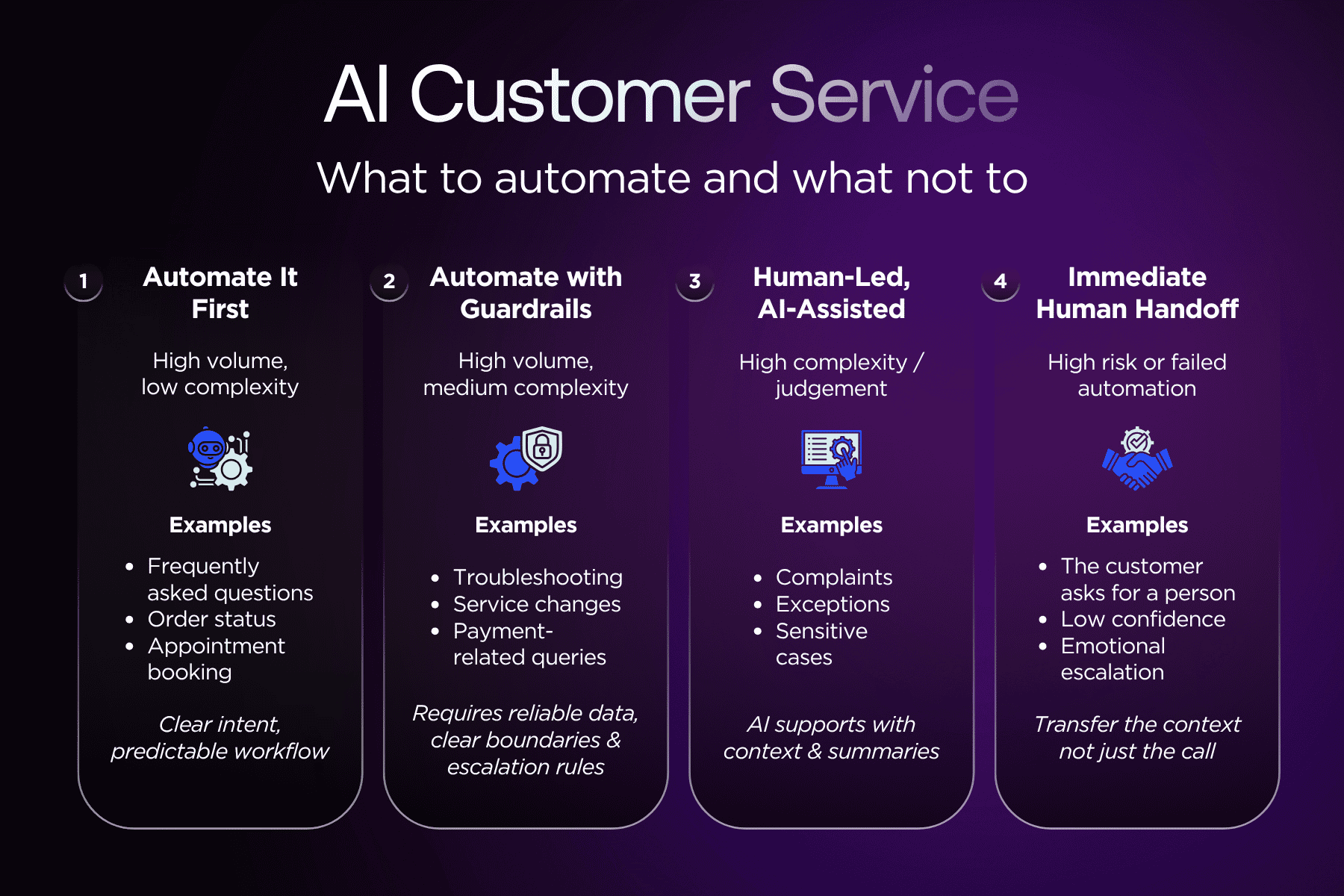
AI can automate customer service tasks when the customer's intent is relatively clear, the necessary data is available, and the next action follows a predictable workflow.
In voice customer service, that can include:
-
answering frequently asked questions and providing information,
-
checking order, delivery or service status,
-
booking, rescheduling or confirming appointments,
-
collecting customer information before an agent interaction,
-
identifying customer intent and routing a call,
-
triggering predefined actions in connected business systems,
-
handling simple accounts or service requests,
-
conducting surveys or structured follow-ups,
-
summarizing interactions and updating customer records.
The important shift is from AI that talks to AI that can complete a workflow. A traditional IVR asks customers to adapt their request to a predefined menu.
An AI voice agent can understand customer requests in natural language, identify intent, retrieve information from connected systems, and trigger predefined actions. Through integrations with CRM platforms, customer service applications, and VoIP telephony, AI voice agents can support request resolution and transfer conversations to human agents when necessary.
But that capability depends on something beyond the AI model itself.
The AI needs access to the communication and business infrastructure around it.
A voice agent that understands a customer's request but cannot access the relevant workflow, transfer the call correctly, or interact with the systems containing the necessary customer information remains fundamentally limited.
This is where VoIP integrations with CRM and customer communication platforms become particularly relevant. Connecting telephony with CRM, customer-support and communication environments allows voice interactions to become part of the wider operational workflow instead of remaining an isolated channel.
AI customer service at a glance: AI or human?
| Customer interaction |
Best fit |
| Frequently asked questions |
AI |
| Order or delivery status |
AI |
| Appointment booking or rescheduling |
AI |
| Initial customer data collection |
AI |
| Intent detection and basic call routing |
AI |
| Structured outbound reminders |
AI |
| Complex exceptions |
Human |
| Negotiation or judgement-based decisions |
Human |
| Sensitive or emotionally charged conversations |
Human |
| High-risk or high-value decisions |
Human |
| Repeated automation failure |
Human |
| Customer explicitly asks for an agent |
Human handoff |
The dividing line is not fixed. As AI capabilities improve and more business systems become accessible through APIs and integrations, the number of interactions that can be automated will continue to grow.
But the principle should remain the same:
Automate where AI can improve the outcome, not simply where automation is technically possible.
The next phase of AI customer service is integration, not just intelligence
Businesses spent the first stage of generative AI asking what models could do.
The next stage is about connecting those capabilities to real operational environments.
The trend is already visible in enterprise investment.
Data presented by Global Link in The State of the CIO Greece 2026 at the 21st IT Directors Forum showed that 62% of respondents currently direct IT investment towards AI, GenAI or Machine Learning, while 55% identify scaling AI from pilots into production as a technology priority for the next two years.
Perhaps more revealing is the maturity gap.
According to the same research, 52% of organizations are already at a production or scaling stage with AI, yet only 19% report having a clear enterprise AI strategy and governance model.
In other words: AI adoption is moving faster than AI governance.
And that changes what AI-ready should mean.
What does being AI-ready mean?
Being AI-ready is not simply choosing an AI provider. It means building an architecture in which AI technologies can be introduced, connected, replaced or expanded without rebuilding the entire customer communication environment every time the technology changes.
That becomes particularly important for voice.
Models will change. AI platforms will change. Customer-service applications will change. The communication layer needs to remain capable of connecting them.
This is why a platform-agnostic approach to AI Voice & Conversational Platform integrations matters. Instead of making telephony dependent on one AI vendor, businesses can connect different conversational AI technologies with the voice infrastructure required to make and receive real phone calls in production environments.
The same principle extends beyond AI. VoIP integrations with communication and collaboration platforms can connect business telephony with environments such as Microsoft Teams, Webex, Genesys and Twilio without requiring the communication strategy to revolve around one closed ecosystem.
AI should fit the architecture not define it
One of the biggest strategic risks in the current AI market is building customer-service infrastructure around the capabilities or limitations of one provider.
A more resilient approach separates the layers.
The AI layer provides intelligence and conversational capabilities.
The business applications provide customer data and operational workflows.
The telephony layer provides the connectivity required to make, receive, route and transfer calls.
The value comes from orchestrating those layers together.
At modulus, we approach Voice AI as part of an open communication ecosystem: telephony should be able to connect with different AI voice platforms, CRM systems, customer-service applications and communication tools without forcing the business into a single technology stack.
That is what makes a communication environment genuinely AI-ready.
When should AI transfer to a human?
Human handoff in AI customer service is the process of transferring a customer interaction from an AI voice agent to a human representative. It should occur when a customer explicitly requests human assistance, when AI cannot reliably resolve the issue, or when the interaction requires human judgment, empathy, negotiation, or decision-making authority.
This sounds simple, but it is one of the most important design decisions in AI customer service.
Gartner's 2026 customer research found that 87% of customers consider access to a human agent essential when companies use GenAI for customer service. The same research warns against allowing AI to become an obstacle between customer and human support.
A human handoff should normally be available when:
-
the customer explicitly asks to speak with a person,
-
the AI's confidence in the customer's intent or the correct response becomes too low,
-
the request falls outside approved automated workflows,
-
repeated attempts have failed to resolve the issue,
-
the interaction requires judgement or negotiation,
-
the customer becomes frustrated,
-
the conversation is emotionally sensitive,
-
the request involves a high-value or high-risk decision,
-
an exception requires authority that AI does not have.
The important principle is this: AI needs to know not only how to respond, but when to stop trying.
A transfer should move the context, not just the call
When an AI voice agent transfers a call to a human representative, the handoff should ideally include relevant conversation context and customer information. This allows the human agent to continue the interaction without requiring the customer to repeat their request, improving service continuity and reducing customer effort.
The human agent should ideally receive relevant context such as:
-
who the customer is,
-
why they contacted the business,
-
what information has already been collected,
-
what actions the AI attempted,
-
what has already been communicated,
-
why the interaction was escalated.
This is where AI, telephony, CRM, customer-service platforms and business applications need to operate as part of the same workflow.
For organizations using cloud-based business telephony, a cloud vPBX can provide the routing layer that directs incoming calls to the appropriate team or person and supports call queues and structured call flows.
The quality of an AI customer service experience may therefore depend less on how convincingly the AI speaks and more on how effectively the entire customer journey is orchestrated.
Good AI handoff should feel like continuity, not escalation
From the customer's perspective, a successful handoff should feel like the same interaction continuing through a different resource.
The channel may change from AI to human.
The context should not.
That distinction will become increasingly important as AI voice agents move deeper into real-world customer service operations.
Is AI good for customer support?
Yes. AI can improve customer support when it reduces customer effort, resolves appropriate interactions quickly and gives human agents more capacity for complex work. Poorly designed automation, however, can make the customer experience worse.
AI can make support available around the clock.
It can absorb peaks in demand.
It can provide immediate responses.
It can automate repetitive requests.
And it can help human teams spend less time on predictable tasks.
But automation is not automatically a better customer experience.
A useful AI agent that resolves a straightforward request immediately may provide a significantly better experience than making a customer wait for a human agent.
A sophisticated AI system that traps the customer in an unsuccessful conversation may provide a significantly worse one.
This leads to one of the most important principles in AI customer service:
Customers care less about whether AI or a human handled the interaction than whether the interaction worked.
The quality of AI customer service should therefore be evaluated through outcomes such as:
-
first-contact resolution,
-
successful automation rate,
-
customer effort,
-
escalation quality,
-
resolution time,
-
repeat contact rate,
-
customer satisfaction.
Not simply through the percentage of contacts that never reached a human agent.
This wider perspective also matters when building a customer support call center. AI is one layer of the environment; routing, telephony, support platforms and operational processes still determine whether the customer ultimately receives the help they need.
Voice AI is becoming part of a wider customer-service stack
Voice AI is evolving from a standalone customer-service tool into one component of a broader technology stack combining AI models, telephony, APIs, CRM systems, contact-center platforms and business workflows.
That shift changes the strategic question. The future is unlikely to consist of one AI application doing everything.
Instead, it will involve multiple models, agents, communication channels, APIs and business systems working together.
A voice agent might use one technology for speech recognition, another for reasoning, CRM for customer context, an ERP or e-commerce platform for operational data and a telephony provider to connect the interaction to the public telephone network.
The most important capability may therefore become interoperability. For customer service, the strategic challenge is not simply selecting the “best AI voice platform”.
It is creating an environment capable of connecting the right AI technology to the right communication workflow.
This broader transition is already visible in the evolution of Voice AI for business and AI voice agents for customer service, where conversational AI is increasingly discussed as part of real communication infrastructure rather than as a standalone experiment.
At the center of that architecture remains business VoIP telephony, providing the underlying voice connectivity through which calls, phone numbers and communication applications can operate over IP.
From AI models to AI ecosystems
This distinction matters because the AI market is moving extremely quickly.
A business architecture designed around one model risks becoming obsolete as new models, providers and agent frameworks emerge.
A communication architecture designed around connectivity and interoperability gives businesses more room to evolve.
That is the advantage of being platform agnostic.
Not avoiding technology choices.
But avoiding unnecessary dependence on any single one.
From AI-first to outcome-first customer service
There is understandable pressure on businesses to move quickly. In Greece, The State of the CIO Greece 2026 research presented at the IT Directors Forum found that 52% of organizations identify adapting to the AI era as their biggest current business challenge.
The research also showed that 80% see the role of IT becoming more strategic, with productivity, measurable business value, innovation and IT-business alignment among the pressures shaping technology leadership. Internationally, the same urgency is visible.
According to Gartner, 91% of customer service and support leaders reported executive pressure to implement AI in 2026. Their priorities included customer satisfaction, operational efficiency, self-service success and reducing customer effort rather than simply replacing staff.
But urgency should not turn AI into the objective itself. The more mature question is not: “Where can we put AI?”
It is: “Where can AI genuinely make this customer interaction better?”
Sometimes the answer will be fully automated voice interaction.
Sometimes AI will work quietly in the background, assisting a human agent.
Sometimes its most important action will be recognizing that it should hand the conversation over.
The strongest customer service architecture will be able to support all three.
The future is not AI versus human
The future of customer service is likely to be hybrid: AI will automate more routine interactions, while human agents will concentrate increasingly on complex, sensitive and judgement-based work.
The dividing line between the two will continue to move as AI capabilities improve.
That is precisely why businesses should avoid designing customer communication around a single model, platform or generation of AI technology.
The competitive advantage will not come from choosing between AI and humans. It will come from being able to orchestrate both and to connect new technologies to the customer journey as they evolve.
A flexible communication environment can connect AI Voice platforms, CRM and customer communication systems and communication and collaboration platforms without forcing organizations into a single technology ecosystem.
For telecom infrastructure, that means becoming the connective layer rather than another closed technology silo.
For customer service, it means moving from AI-first to outcome-first.
And for the customer, ideally, it simply means getting the right help from AI when AI is enough, and from a person when a person matters.
AI Customer Service: Key Takeaways
AI customer service works best when automation is designed around the customer journey rather than around the technology itself.
AI voice agents can take over repetitive, high-volume interactions, but human agents remain essential when judgement, empathy, exceptions or trust become part of the conversation. The real opportunity lies in connecting both sides effectively: giving AI access to the right workflows, enabling seamless human handoff and building a platform-agnostic communication layer that can evolve as AI technologies change.
Ultimately, successful AI customer service is not about maximizing automation, it is about reducing customer effort, improving resolution and using AI where it creates the most value.